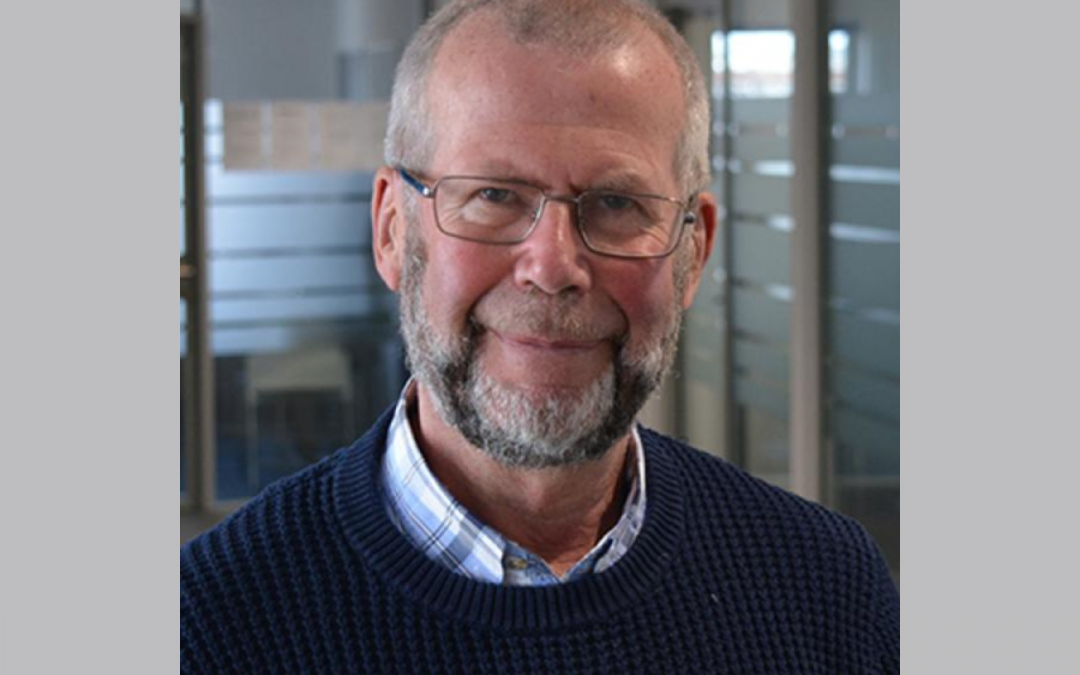
It is with great sadness that we report the death of Professor Paul Mosley, Director of the Institute for Development Policy and Management (IDPM), University of Manchester, from 1986 to 1992. Professor David Hulme, who worked closely with Paul, reflects on his immense contribution to Development Studies.
Professor Paul Mosely was an internationally recognised scholar of development economics, holding positions at the universities of Strathclyde, Bath, Manchester, Reading, and Sheffield over his long career. Paul was also deeply committed to improving the efficacy of foreign aid and national development policies, working as a professional economist for the UK’s Overseas Development Administration (ODA) early in his career and as an advisor to NGOs and international agencies, including the UN and OECD. Motivating all his work was Paul’s passionate and energetic desire to make the world a better place, and especially to help improve the livelihoods of people across Africa.
Although Paul was a trained economist with an impressive record of publications in journals such as the Economic Journal, he believed the discipline required input from the social sciences if it were to improve public policy. As a result, he researched and published extensively on politics, political economy and governance in many of the world’s leading journals. His early publications focussed on African economic history, which became the topic of his PhD at Cambridge University and eventually that of his book, The Settler Economies (Cambridge University Press, 1983), analysing colonial economic policies and outcomes in Kenya and Zimbabwe.
At the University of Manchester in the 1980s and 1990s, Paul Mosley made major contributions to both the University and to international development policy. He transformed the University’s Department of Administrative Studies for Overseas Visiting Fellows (DAS) from a neo-colonial, aid-dependent, training and consultancy unit into a research and post-graduate education institute (IDPM). His personal research became very policy-focussed and closely related to his founding role in an influential think-tank, the Independent Group on British Aid (IGBA). He was also a Trustee at ActionAid, helping the organisation advocate for better international development policies in the UK, EU and World Bank. During his time at Manchester, he authored several of his best-known publications. These included Foreign Aid: its Defense and Reform (1987) at a time when the UK government was reducing its aid budget ; the two-volume Aid and Power (1995), with John Toye and Jane Harrigan, which provided a highly original analysis of World Bank and IMF policy conditionality and its poverty-creating consequences; and, the two-volume Finance Against Poverty (1996), which we co-authored, challenging the widely claimed role of microcredit in poverty reduction. Working as a co-author with Paul was never easy (I think we could all say it was maddening at times) but, my goodness, was it intellectually productive. I learned so much about research and policy advocacy from Paul that it shaped my academic career…’many thanks, Paul’.
Paul’s energy and commitment to what universities now call ‘impact’ were amazing. I remember meeting with Paul at his home late one Sunday evening in 1992 when both our sets of young children had gone to bed. We discussed revising a draft of our microfinance research findings (over a wee dram) and, as I was about to leave, I noticed the hand-written notes on his desk were in French (Paul had the most illegible hand-writing imaginable). “Oh, I’m flying to Paris on the 0600 tomorrow, that’s today now…my lecture at the Sorbonne is in French but the OECD in the afternoon is okay as that’s in English”. Often it appeared that Paul did not need to sleep!
During his time at Sheffield, Paul’s research and publications broadened. Poverty and Social Exclusion in North and South (2005), with Elizabeth Dowler, was innovative in contrasting poverty and poverty reduction approaches in high-income and low-income countries. The Politics of Poverty Reduction (2012) moved on to looking at how the conditions for the application of evidence to policy practice could be created. And, with Barbara Ingham, Paul wrote Sir Arthur Lewis: a Biography (2012), building on their scholarship and Paul’s detailed primary research in Manchester interviewing Lewis’s (ageing) social activist colleagues. As Paul discovered, Lewis was very concerned about race relations and inequality in Manchester and the UK in the 1950s.
Alongside his personal research Paul Mosley took on an intellectual lead in shaping the emerging discipline of Development Studies. This included serving as President of the UK’s Development Studies Association (DSA) from 1998 to 2001 and editing the Journal of International Development for more than 25 years. Paul was keen for development economists to work with social scientists from other disciplines. He knew that effective policy formulation and implementation required cross-disciplinary analysis, but he struggled as the Economics discipline in the UK followed Economics in the USA: highlighting assumption-based, neo-liberal, mathematical models tested on datasets that were often of questionable reliability. He did not follow the Economics ‘herd’ but continued to work with colleagues from other disciplines (politics, sociology, nutrition and others), to adopt Q-squared research methodologies (integrated quantitative and qualitative methods) and to undertake primary data-collection. This became unfashionable in Economics: but if you wanted to know why poor people or policymakers did something then why not ask them ‘why’ yourself?
Paul remained a great friend of, and regular visitor to, Manchester’s Institute for Development Policy and Management (IDPM) and Global Development Institute (GDI) over the years. He researched with IDPM’s Chronic Poverty Research Centre (CPRC) and its Effective States and Inclusive Development (ESID) research consortium from 2000 to 2020; served as external advisor on many appointment and promotion committees; as external examiner for PhD candidates; and participated in academic conferences and workshops convened by Manchester’s academics.
But Paul was not just an outstanding academic and an influential policy advocate. He was husband to Helena an artist, (and also a saint to cope with his frequent: “have I told you I am going to Zimbabwe tomorrow for a couple of weeks?” lines); devoted father to Francesca and Nick; and an enthusiastic grandfather of four. Paul was also an excellent companion to travel with in Africa or in Europe. He was not surprised by power cuts, high temperatures, warm beer or cockroaches but enjoyed a meal in more sophisticated settings (though I believe he preferred a coconut in the village to a wine at the Hilton). He adored mountains and was a keen outdoorsman (at Manchester he chose to live in a cottage below Kinder Scout, a mere ‘hill’ compared to his beloved Skye). Indoors, Paul was a talented linguist and lover of literature (Italian was his favourite of the seven languages he spoke) and an accomplished clarinettist, playing orchestras all his life.
If you have a minute go to the library (Paul loved real books) and look at Aid and Power or Finance Against Poverty or Sir Arthur Lewis to appreciate his contributions to knowledge and action. Throughout his life Paul ‘broke the mould’ of a traditional academic with his innovative thinking, passionate teaching, contributions to improved aid policy and wide-ranging interests. He will be greatly missed by family, friends, academic colleagues and the thousands of students he taught over his well-lived life.