
Coordinated and edited by Caroline Cornier and Michaela Collord
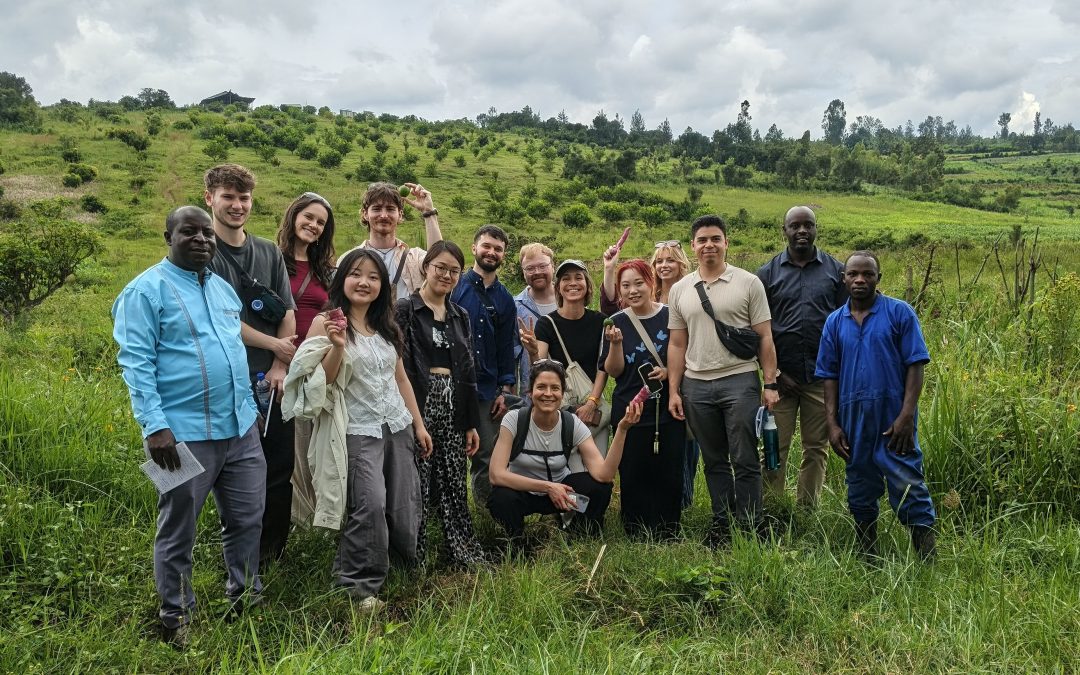
Featured image: Visit to local entrepreneur Charles Ashimwe’s fruit tree and vegetable plantation
Between the 21st of March and the 3rd of April 2026, the University of Manchester took Development Studies master’s students on its annual field trip to Rwanda. Rwanda, led by ex-militia leader Paul Kagame, is a small land-locked country in East Africa. Since its tragic 1994 genocide, it has made impressive progress in social and economic development indicators. Successes include: near-universal health insurance coverage; a crackdown on corruption with Rwanda ranked 41 of 180 in 2024 according to the Corruption Perception Index; and high annual GDP growth, reaching almost 9 percent in 2024. Its outlier position in the African context makes Rwanda a particularly interesting case study for Development Studies students. Yet, at the same, Rwanda is regularly critiqued for its authoritarianism. Its long-standing intervention in neighbouring Democratic Republic of Congo is also blamed for causing regional instability, displacement, and economic exploitation of Congo’s mineral wealth. In March 2026, Rwanda’s involvement led to US sanctions against the Rwandan Defence Force.
In this blog post, master’s students from the MSc in Global Development reflect on their fieldwork experience in this multifaceted context. The students are from the Politics and Governance of Development Policy (PGDP) pathway and, during their time in Rwanda, focused especially on the theme of land governance. Field visits included exchanges with government bodies such as the Rwanda Governance Board, the government’s digital service platform Irembo (including for land titles) and the City of Kigali, who mediated the visit of an urban rehousing project. These institutional visits were complemented by discussions with private sector actors around, for example, the visit of a solar-powered irrigation project, a palm oil processing factory, and coffee and fruit tree plantations, as well as interactions with civil society organisations such as with the NGO ActionAid and the Anglican church.
Vincent Flores – Land Governance Impacts on Housing and Urban Development
Before fieldwork, I wrote a paper on land confiscation in Kigali, examining how this strategy promotes urban growth and attracts investment. While I expected to see a highly coordinated and efficient system, what stood out most during the trip was the extent to which this system relies on strong central control and involves difficult trade-offs, such as rural populations’ forced relocation in exchange for basic service provision.
Throughout meetings, Rwanda’s centrally conceived ‘master plan’ consistently emerged as the dominant framework shaping land use. On the surface, the master plan presents itself as an ambitious development vision that coordinates all initiatives into one plan, which can attract investors. However, when witnessing the plan in practice, it raised different observations. For example, in a meeting with the District Mayor of Kayonza it became clear that while planning processes are described as decentralized, all decisions must ultimately align with the master plan, particularly when it comes to land use.
Additionally, visits to rehousing projects further highlighted tensions between development and affordability. While these initiatives improve infrastructure and formal housing, they also raise questions about who benefits, particularly for lower-income residents affected by relocation.
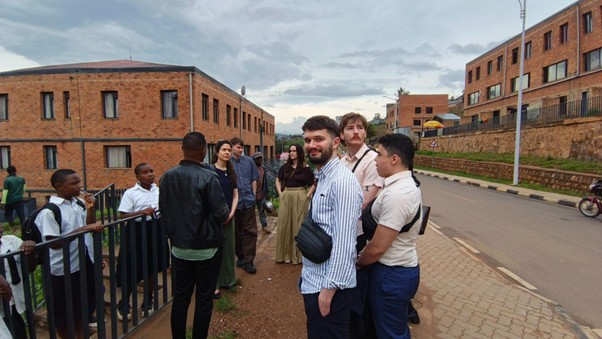
Visit to the Mpazi rehousing projects in Kigali
Overall, the trip challenged my initial assumptions by showing that development is not only about policy design, but about how power, planning, and priorities shape outcomes on the ground. Because Rwanda has a unique political structure and state capacity for the region, I believe Rwanda offers insightful research for the topic of development.
Ebony Thorogood – Gender and Planned Settlements
Going into the field trip, I aimed to explore how Rwanda’s planned settlements shape gendered experiences. This was more difficult than expected since information gained about planned settlements was quite unclear amongst different governmental organisations, especially about gender dynamics which were not addressed at all. This disconnect revealed an important methodological issue that policy does not always translate into practice, and research questions that seem straightforward on paper can dissolve in the field.
At the same time, the absence of answers was itself revealing. It highlighted how centralised planning frameworks can obscure the lived realities of women in rural communities, and how gendered impacts may be embedded in everyday practices rather than formal programmes. The state’s overarching gender mainstreaming objective has produced numerous positives such as women making up 64% of parliamentarians. However, it is hard to ignore that the strong state gender narratives often overshadow more nuanced or critical discussions especially about poorer rural women.
Overall, the fieldwork shifted my thinking about development research as it underscored the need for flexibility, reading between the lines, and for recognising that ambiguity can be as analytically meaningful as explicit information. Rwanda’s unique governance context made these dynamics especially visible and a very interesting case to study.
Faye Hough – Gender Gaps in Land Policy
Going into the fieldwork, my research examined Rwanda’s gender reforms with a focus on those excluded from land law, notably women in informal marriages and single women. I expected to encounter a system at least grappling with these gaps, even if imperfectly. Instead, I was struck by how little appetite there seemed to be for re‑evaluation. Inclusion often appeared as something already achieved, a label rather than an ongoing political commitment.
On paper, Rwanda’s gender and land framework is undoubtedly progressive. In practice, however, it often felt performative. Concepts such as “gender mainstreaming” and “inclusive guidelines” tended to apply most clearly to those already legible to the state: women who are formally employed, married, and institutionally organised. For those on the margins, legal ambition rarely translated into lived reality. One of the most visible routes to women’s inclusion was through cooperatives, which formalise grassroots self-help groups and align them with state development priorities. While these structures open up access to training, technology, and investment, they also raise uncomfortable questions about who benefits from formalisation, and whether empowerment becomes conditional on compliance and productivity.
The fieldwork ultimately shifted my thinking from cautious optimism to a more critical stance. Rather than asking why policy has struggled to reach certain women, I began to question why so many were never fully written into these frameworks in the first place and what that says about the limits of inclusion when development is tightly managed from above.
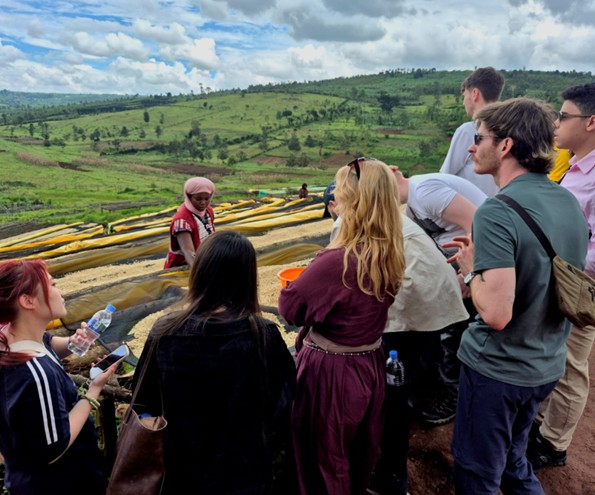
Visit to a coffee cooperative in Rwanda’s Eastern Province, Kayonza District
Fin Hanna – Inequalities
During my visit to Rwanda, I hoped to uncover how the formalisation of housing through resettlement policies reduced rural autonomy and increased state control. Almost immediately, I understood that this was going to be challenging as we were almost always accompanied by a government official from the Rwanda Corporation, or speaking to those in power positions who were directly benefiting from the current political setting.
I wanted to hear personal recollections of forced relocation, or understand the implications of how the state’s ‘master plan’ labelled land belonging to and lived on by Rwandans as simply ‘industrial zone’, and how vulnerable voices were ignored in development projects. Instead, we were presented only with success stories, translated or mediated by those in authority. I couldn’t help but feel like we were sold a false reality – a sustainable development façade masking deeper societal and class inequalities.
Rwanda’s development process is seemingly skipping the typical industrialisation stage of development, transitioning directly from agriculture to services. Whilst this shows an ambitious modernisation trajectory, it raises some key concerns. The economy remains heavily reliant on cash crops and agricultural exports yet increasingly pushes for urbanisation and service investment. Forced urbanisation without the necessary progression of labour protections, wages, and welfare systems, can surely only increase inequality.
However, this critical perspective should not take away the tangible progress Rwanda has made. It’s hard to ignore the expansion of electricity access, healthcare and schooling, or the constantly laughing and happy-looking children in the streets. During our visit to the Mpazi resettlement project, although it felt uncomfortable and a bit poverty touristy, we were greeted, fist bumped, waved at, by people with inconceivable hardships. Rwanda’s energy is contagious; its optimistic, forward-thinking and grounded in a collective unity shaped by post-genocide recovery.
I didn’t leave Rwanda with clear answers, but with a deeper understanding that development isn’t just about metrics or illustrative successes. It’s about people and their experiences; the lived realities behind policy. Rwanda demonstrates that development can’t be neatly categorised as either a success or failure, but instead as an ongoing process where progress and inequality coexist.
Daniel Byrne – Is Rwanda instituting a form of accumulation by dispossession?
In preparing to visit Rwanda, I researched land consolidation efforts in Rwanda with a particular focus on rural resettlement policies. I analysed these policies and their role in agricultural modernisation and commercialisation, aiming to ascertain the role these policies play in potential (forceful) dispossession of smallholder farmers. I expected to see lots of overt examples of coercive resettlement, including many planned rural settlements alongside intensified agricultural usage.
Like many of my colleagues, my initial assumptions were challenged by what we saw and discussed during our trip. Resettlement and subsequent potential dispossession emerge as a complex and differentiated process which affects different groups in varying ways. The scale of displacement and the ability to negotiate seems to depend on economic and political power groups hold, with some able to have discursive power with national and district government, whereas others have little agency. There remains fascinating analytical space to explore the ramifications of this for rural populations and the effects this may have on Rwandan development.
Our visits to different farming cooperatives were crucial in informing this more detailed critical lens, displaying how land consolidation and intensification limits the autonomy of farmers whilst providing a sense of security from a market they enter on differing terms.
There was a key voice missing from all of our meetings. Those of the (ordinary) smallholder farmers who feel the pressure to comply with government directives on land usage and then feel differentiated effects stemming from this. It seemed like we talked about them a lot without getting a chance to talk unrestrictedly to them. This left a hole in our research process.
Despite this, Rwanda certainly offers an excellent research angle for those looking to research how land consolidation attempted, as part of late-late capitalist-orientated development and agricultural modernisation, produces new power dynamics and potential surplus labour populations.
Hongjin Ren – Urban-Rural Inequality
Before standing on Rwanda’s land, my understanding of the country was largely shaped by organised written works and visual materials. The field trip revealed a noticeable gap between these representations and the realities on the ground, highlighting how certain details and experiences of development remain inaccessible through secondary sources alone.
Rwanda is often considered a strong example of state-led development. However, I found that state power is largely concentrated in the capital city, where land has been carefully zoned into different functions in the ‘master plan’. In rural and remote areas, where direct state presence is limited, cooperatives fill gaps in state provision and have become the primary means through which land and labour are organised. In this context, cooperatives raise questions about whether they genuinely compensate for, or instead further normalize, state absence in rural areas.
Women’s participation reveals how uneven policy implementation not only reproduces urban-rural inequality but also transforms inclusion into a symbolic commitment rather than a substantive practice in rural areas. In Kigali, we observed female leadership, including female politicians and female government officials. In contrast, in rural areas women’s participation was more often framed as a “government policy that needs to be respected” rather than as a lived practice. In the agricultural cooperative we visited in Kayonza, leadership positions were predominantly held by men. Women are integrated into the system merely as labour.
Even though the presentations and interviews were polished and idealistic, we were offered a glimpse behind the veil of development discourse during the field trip. To me, Rwanda presents a valuable insight into the limits of development knowledge itself, revealing how official narratives often obscure the uneven, spatially differentiated realities through which policies are lived and experienced.

Sign in the Kayonza District Town Hall
Lewys Rees – Green Environmental agenda in the context of land formalisation
The difference between my vision of development policy going into the field and my perspective whilst I was there altered considerably, primarily due to seeing the impacts that development policy has on an individual. I was critical of the ethical considerations surrounding the formalisation of settlements, but now, on reflection, I can see the micro-level benefits alongside my concerns.
We talked to individuals to understand how their quality of life has improved by the formalisation of land, which surrounds my topic of interest: energy policy. It is remarkable to contextualise how Rwanda, as a country, has gone from 2% electrical connection in 2000 to around 82% (depending on the statistics). You could observe the difficulties of integrating renewable energy production. The government’s will to integrate green energy policy into its ‘master plan’ was remarkable, which our visit to a solar-powered irrigation project was emblematic of. What changed fundamentally for me on the topic of energy transitions in the Global South, was my perception of how the private sector and the state have to work together to achieve a common goal with different motives. The state can formalise land through the investment of the private sector – in this case the Howard Buffet Foundation – to attract farmers to work in a cooperative. Farmers increase yields and subsequently profits but become dependent on the cooperative and the inputs it provides. This highlights how development policy brings together different actors and causes multidimensional effects.
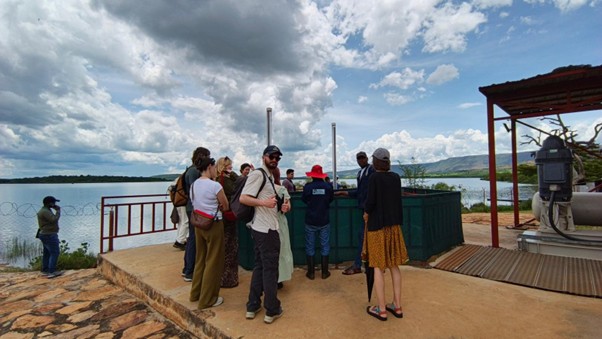
Visit of the Nasho solar-powered irrigation project’s water pumps in Rwanda’s Eastern Province, Kirehe District
I think it is easy to criticise the formalisation of land, but in the increasingly difficult contemporary context for ‘late-late development’ it becomes hard to judge. That being said, we should not forget the ethical and critical issues surrounding the formalisation of land. This makes the topic so fascinating as an example of a ‘double-edged sword’ in development studies.
Yuhan Feng – Inclusive Development
Our field trip left a strong impression on me. I understood Rwandans’ pride in showing what the country has achieved in terms of development since its tragic past by seeing the green infrastructures and effective governance of Kigali firsthand.
However, I became more conscious of the contradictions between progress and inclusion. I posed officials the question: Where do plans for the city envisage a role for low-income workers in Kigali’s future? The response was that low-income labour went against national achievements and visible progress. It began to draw my attention to the discourse of progress and whose place in the city remains uncertain.
I perceived a similar tension in gender. While Rwanda is known for women’s representation, I felt that many women at the grassroots level were working in basic and low-paid work as opposed to occupying visible roles of leadership in the day-to-day lives of women.
For me, the greatest lesson I learned from this trip was not how to advance development faster, but how to advance development more inclusively. I am not denying the success of Rwanda, but the question remains: are the people who help sustain cities being recognised and included fairly for a better future?
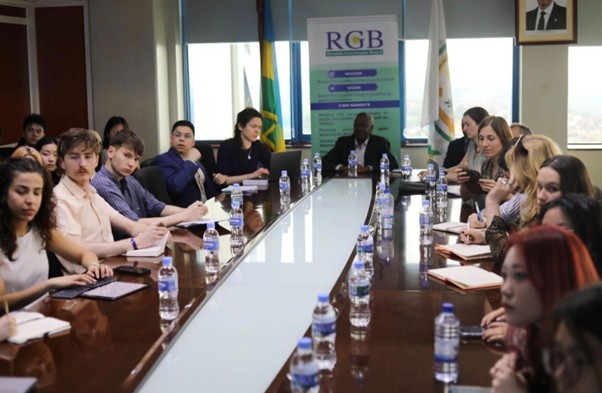
Visit to the Rwanda Governance Board
Ruojia Wang – Rwanda’s Digital Leap: The Clash of Technocracy and Social Inclusivity
During my trip to Rwanda, I was particularly interested in the government’s digital service platform Irembo, which represents a significant breakthrough in the country’s digital governance. Having a similar platform in China that conveniently integrates government services, I know first-hand how such systems can greatly facilitate citizens’ daily lives. By centralising complex procedures like land registration, identity verification, and visa applications into a single digital platform, Irembo significantly reduces the time required to access public services and hence demonstrates Rwanda’s strong administrative capacity.
However, this success also prompts critical questions. While we praise Rwanda’s digital leap, we must consider the realities of residents in remote areas. For these populations, challenges such as a lack of digital literacy, absence of smartphones, poor network connectivity, and low general literacy rates severely hinder their access to Irembo. Does this create a form of political exclusion? Will this technological barrier result in the marginalisation of those lacking digital skills? As local governments increasingly rely on Irembo, citizens can no longer depend on face-to-face interactions with local officials to report problems as they did before. When everything is forced into a standardised digital process, these vulnerable citizens are de facto deprived of their right to access state services.
Although I raised these concerns with Irembo staff, their responses only reiterated the official technology orientated government narrative. I had hoped to speak directly with local residents about their lived experiences with Irembo, but unfortunately, we lacked this opportunity.
Overall, Irembo is commendable for integrating scattered resources into an intelligent, state-led service system. However, its potential pitfalls remind me that development is never merely a technological leap; it requires a deep consideration of realities on the ground, including spatial inequalities between the centre and the periphery, as well as broader socio-economic disparities.
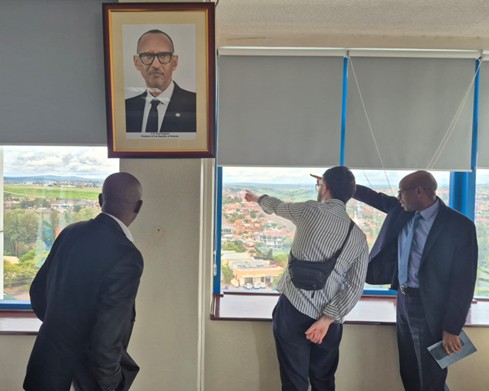
View over Kigali from the Rwanda Governance Board
Cailem Taylor – Urban Informality
Our trip to Rwanda ultimately left me with more questions than answers. Prior to the fieldwork, much of my time was spent poring over highly critical analyses and hesitant predictions of Rwanda’s approach to urban informality. On the ground it was clearer that the reality was more complex, with the balance of government and citizen interests often in a push and pull relationship.
Initially, I intended to uncover truths about living conditions following urban resettlement or regeneration. The visit to the Mpazi rehousing project was a perfect opportunity. Residents were involved in the planning and construction process; many of them requesting a balcony for their new homes, for example. Infrastructure and material quality of life was certainly raised.
However, we probed for details with questions about affordability and compensation, but that only presented new questions once vaguely answered. We did not get to personally engage with residents to get their perspective, instead being told by a member of the government that the residents were always convinced to say yes to relocation.
This reoccurrence of missing out on the perspective of the vulnerable or those most affected by government policy remained a theme throughout. Despite what could have been a frustrating situation, it provided a unique lens to view development and urban informality through. A constant message of participation from the top, but confusion and uncertainty at the bottom of society. Rwanda remains an interesting and complex space to research informality in a unique development story, showcasing the vision of a long-term oriented government and growing urban population.
Note: This article gives the views of the author/academic featured and does not necessarily represent the views of the Global Development Institute as a whole.
Please feel free to use this post under the following Creative Commons license: Attribution-NonCommercial-NoDerivatives 4.0 International (CC BY-NC-ND 4.0). Full information is available here.