
Written by: Mariana Hernández Montilla, Anuradha Ganapathy,
Krishna Das, Maria Pampaka, Sandra Barragán & Helen Underhill
29 April 2026 · Whitworth Art Gallery, University of Manchester
Before you read, take a moment. Think of one relationship that holds your own work together. Keep it in mind as you go. Close the essay by looping back to it
Introduction
We gathered at the Whitworth on a sunny Wednesday morning in April. Six female researchers. Six disciplines. Several continents of fieldwork between us, and on paper, almost nothing else in common. Our work spans forest restoration governance in Mexico, gender inequalities in mathematics education, remote sensing of forest disturbance in Northeast India, digital technologies and just economies, land rights in energy transitions, and learning in/through changemaking.
We had agreed to spend the day with one sentence. “In my research, success depends on relationships between…”
Together, we found that success depends on relationships between people, places, and knowledge systems. Between communities and their territory, between a satellite image and the forest it can no longer be seen, between a place and what mining left in the ground, between technology and the stories and food shared while studying it.
We wrote. We walked in the park. We ate lunch together and built a board with pinned sticky notes, mapping what institutions measure, what holds the work together, and what gets lost when we write the report. The pink notes at the bottom were the most crowded part of the board. The coloured tags beneath each author’s name carry threads from that board into each section: the values, losses, and questions each of us kept returning to.
What we found was not what any of us had planned for. Each of us encountered the same gap. The things that make our research meaningful – agency, solidarity, trust, rootedness, traditional knowledge, care – are precisely the things that institutional frameworks struggle to see. These carry the weight of whether our work succeeds or fails, and they rarely survive the journey into a report.
We also found something on a second scale.
The relational gap in our research topics ran through our own working lives as well. The supportive colleague. The supervisor who believed in the vision when it was still uncertain. The generosity of research partners who open their doors. The conversations in corridors and community halls shaped our thinking in ways no methodology section can hold. Both layers appeared on the board. Both are erased by the same metrics. Both make our research possible.
This essay is the result of that day. Six voices, each writing from their own ground, woven around the threads we found together.
Mariana
Global Development Institute · Forest Restoration, Environmental Justice, Futures
Rootedness · Recognition · Local knowledge
The futures we measure in roots
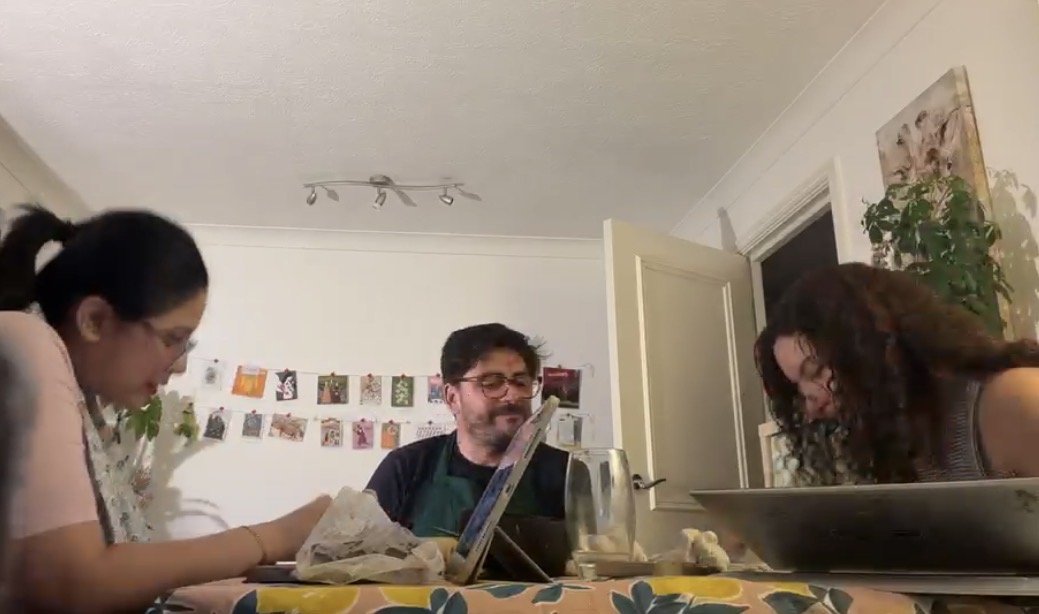
Cocreation process using clay
In the Mixteca Alta of Oaxaca, there is a word that resists translation: Arraigo. Rootedness comes close. Attachment to place comes a little closer but still misses its weight. Arraigo is a relationship – held between a family and a hillside tended across generations; between a community and the decisions it makes in assembly about its own forest; and between the knowledge a grandmother holds about seeds and soil, and the willingness of her grandchildren to stay.
I began this work by asking how policy shapes restoration on the ground. I wanted to understand how international commitments to restore degraded land impact local communities. Through fieldwork, moving between formal interviews and long planting sessions, I found that the distance between global frameworks and community experience was not about implementation, but about fundamentally different definitions of success, shaped by place and by the people who hold it.
In twenty‑four Mexican policies spanning 1988 to 2024, I found that only three established shared decision‑making mechanisms for Indigenous peoples and local communities. The rest assumed that communities would participate in programmes designed by someone else, somewhere else. This lack of agency and stewardship determines almost everything about whether restoration lasts. But the finding I had not planned for was what happened when communities and I made something together. Alongside the fieldwork, I cocreated an animated documentary, Los Seres del Bosque, with characters who speak about water, soil and memory. What the film made possible were conversations that interviews could not reach. Knowledge arrived through making with past, present, and imagined futures held in the same frame.
For me, success depends on being inside the relationship long enough for it to ask something of you; only from within can its obligations and possibilities become visible. The metrics I report count hectares and publications and policies. They do not count the walk through a community forest where someone showed me what restoration meant by pointing at a tree that had been there longer than any programme. They do not count coming back, and back again, until the relationship makes different questions possible.
What I want for research, and what our workshop briefly made possible, is an imagination space alongside rigour. Room for thinking about the future of others, and for growing the knowledge through presence, through return, and through making things together in ways no metric can hold. The clay figures in the photo came from that same place: three of us at a table, shaping the characters of the documentary before bringing them to the communities, working with our hands to reflect traditions so others could recognise themselves and reshape the story with us.
Maria
Manchester Institute of Education & Social Statistics · STEM, gender inequalities
Measurement · Gender · Complexity · Emotions · Aspirations · Time
The Ecology of Research Success: Dependencies, Affordances, and Relational Futures
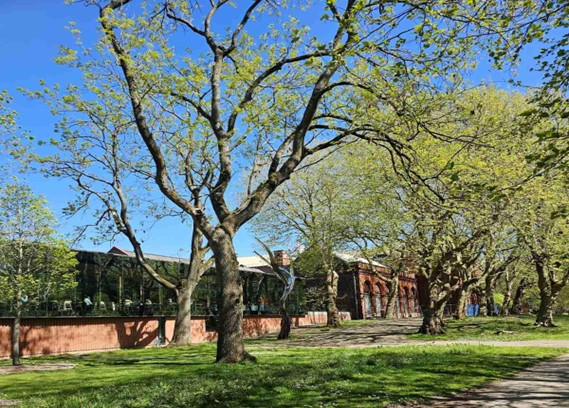
“The dancer tree outside the museum” – or the artificial among the natural
My research varies from primary mixed methods studies of students and teachers in their schools involving primary data collection, to desk-based systematic reviews of literature and secondary analyses.
Across these different forms of work, what counts as “success” depends on very different – and very human – relationships.
For my school-based studies success depends first on access: head teachers and administrators willing to open their schools to research. It depends on parents consenting for their children to take part. It depends on students and teachers being willing to complete questionnaires, participate in interviews, join focus groups, or allow observations into their classrooms. None of these are methodological steps; they are relational negotiations.
Thinking about delivering (funded) research projects more broadly, success depends on another set of relationships: the efficiency of institutional processes, the responsiveness of stakeholders and the researchers hired to support or carry out the work. Under precarious conditions and part-time contracts this has often proved fragile. At times, the success of a project depended less on design or expertise and more on my ability to create additional time to make the work possible.
And then there is a different kind of relationship – the one with myself. Even when outcomes might be considered “successful” by institutional standards (a prestigious grant, a publication in a highly recognised journal) a persistent question remains: what’s the point? Who (else) cares?
This may often feel like imposter syndrome, but it is also about whether the work we do translates into something meaningful for others – particularly in my case, for the learning experiences and opportunities of the next generation.
What gets lost in the pursuit of academic success is not only the balance between personal and professional life, or a degree of mental stability. What is also lost are all these relationships and processes that made the work possible in the first place: the negotiations, the dependencies, the delays, the improvisations, the goodwill. The process is often complex and messy, and its beauty lies partly in that chaos – much of which disappears when research is presented in the orderly form required by metrics, outputs and reports.
The artificial take: Research is produced through relational infrastructures that are invisible to current definitions of research success.
And perhaps that is why research so often feels uncertain.
After all, as a line often attributed to Einstein goes, if we fully knew what we were doing, it probably wouldn’t be called research.
Would it?
Anuradha
Global Development Institute · Digital technologies, AI, and just economies
Agency · Experiences · Recognition
When what we don’t see matters as much
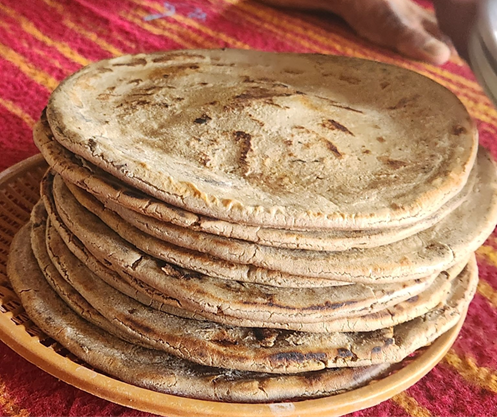
Breaking bread: Conversations over shared meals
In much of the institutional research landscape, success is still measured through familiar signals: scale, efficiency, uptake, innovation.
These metrics make sense if we are defining the futures in terms of growth, speed and size. But not if we are defining futures in terms of care, solidarity, power and justice.
My work sits around AI and digital tools, a field that is more hyped than ever. For me a critical AI future is a future in which communities most impacted by these tools have power and voice in their design, can question if these tools really make sense to them, decide when and how they want to adopt them, and reject them without being penalised in the process. A healthy AI ecosystem is one that makes room for democratic participation, contestation, restraint, refusal, and resistance.
Funder metrics rarely know how to value these outcomes. They ask how many people have used the tool? How many people have you impacted? Can it be scaled? Yet the most meaningful outcomes in my research look very different. Success shows up when efforts are re‑oriented away from building new tools, towards supporting community rights, stewardship practices, and collective decision‑making rather than technological solutions by default.
Then I turn towards academic metrics. I am chasing Q1 journal publications, finding research gaps, and adding something “new” to scholarship. There is little space for me to account for the true joys of the research process – the shared meals, the rickshaw rides, the generosity of field partners, the conversations enroute to places, and the embodied experiences that shape the research processes. At some point, I will be flattening these out in a section titled “research methodology”. But how do I remain accountable to these experiences as a person? How should my research embody these processes?
Perhaps being a researcher is about learning to live with more and more questions and fewer answers.
Krishna Das
Physical Geography · Remote sensing and GIS for forest disturbance, Northeast India
Scale · Local knowledge
Beyond the pixel
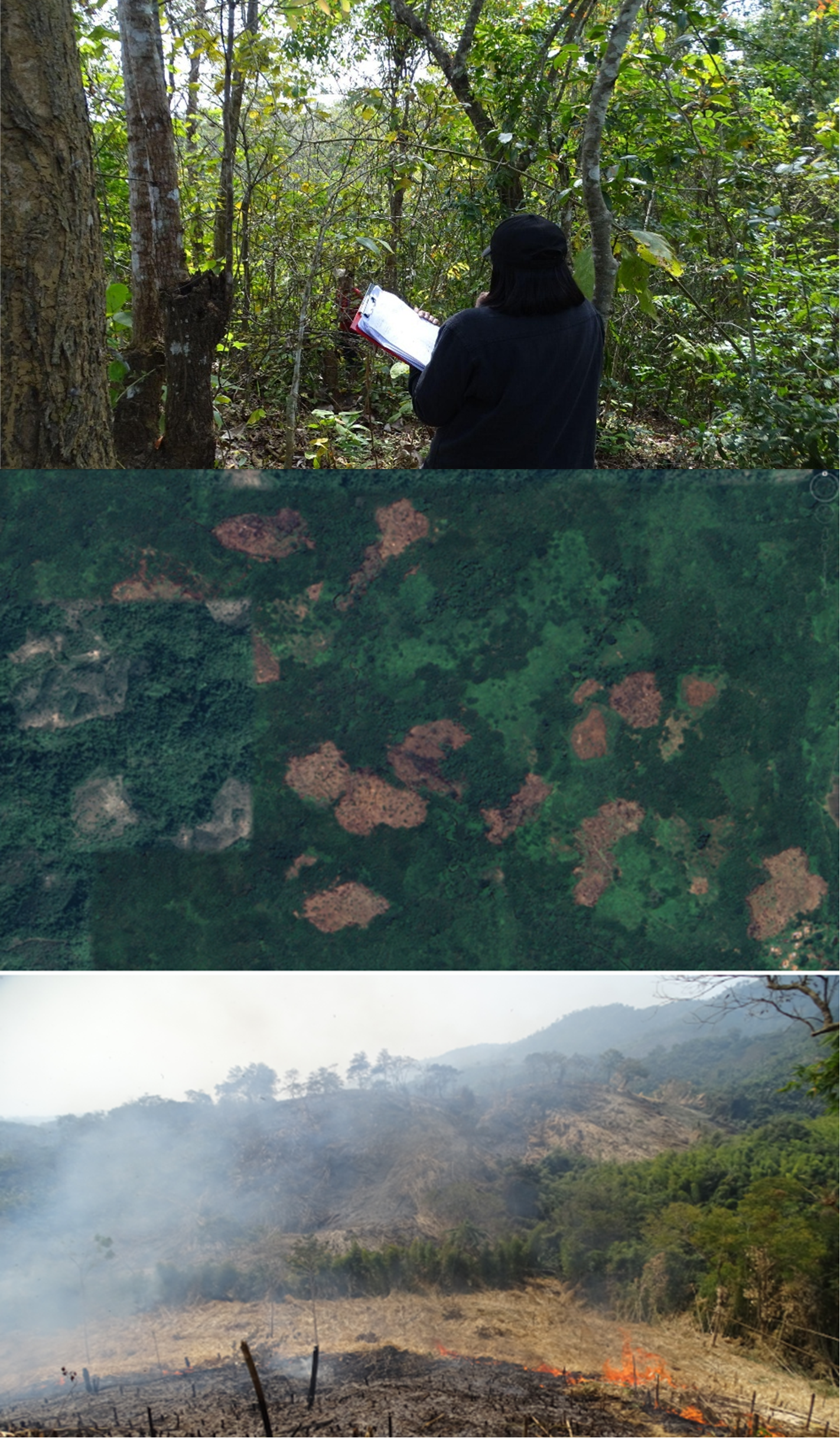
Shifting cultivation seen from space and from the ground in Northeast India
When we look at a pixel on a map, we see only one place at one moment in time. But in Northeast India, a global biodiversity hotspot, can a single pixel really represent a landscape shaped by seasonal disturbance, shifting cultivation, and other forms of forest change? In a region with strong monsoonal seasonality and rapid land-use change, the meaning of “forest loss” depends not only on what is visible from above, but on timing, context, and how change is interpreted.
A shifting cultivation cycle makes that clear. A patch of forest may be cleared, burned, and cropped within a single season, then left to regenerate – a cycle that can span several years – yet a global map product can still collapse that entire sequence into a single category of loss.
Scientifically, that matters because it changes how we interpret disturbance dynamics; politically, it matters because those categories can shape how landscapes are governed and what interventions are considered appropriate.
My research uses remote sensing, GIS, and time-series analysis to study forest disturbance in Northeast India. The question I keep returning to is not only how to map change accurately, but how to represent it responsibly.
We may have advanced the technology to observe the Earth from space, but we are still catching up in how we connect that view to the ground- to the people, the ecologies, and the knowledge systems that satellites cannot yet see. When the knowledge of communities who have lived with these forests for generations is labelled “tradition” rather than recognised as expertise, something important is lost in both science and policy.
The future I want for this kind of research is not less rigour, but more careful forms of rigour: maps that remain technically robust while also being more attentive to the histories, knowledge systems, and lived realities that satellite images alone cannot fully hold.
Sandra
Global Development Institute · Land rights and (in)justice in energy transitions
Solidarity · Recognition · Time
When Research Actually Matters: Lessons from the Field

View of the jungle near the proposed project site in Yucatan, Mexico
In my research, success happens when the information generated through the research is meaningful and useful for advocacy and advancing social justice. A key part of making this success happen is building strong and trusting relationships with the people and organisations who work on the front lines and who actually know what kind of knowledge is needed to advocate for more just outcomes.
To exemplify, let me tell you about a moment when I felt my research was actually making an impact – a moment when I felt that the process and output truly mattered for the people involved. While I was doing my PhD fieldwork in Mexico, I connected with a few grassroots organisations that were struggling against the imposition of large-scale solar farms.
The solar farm, if implemented, was set to deforest over 500 hectares of jungle. As we know, in order to advance a much-needed energy transition away from fossil fuels, we need renewable energy, including solar energy. However, in this case, the company was prioritising profit over sustainability – that is to say, the area chosen for the project was selected because it was cheaper to build there, regardless of the deforestation it would cause.
This prioritisation was, of course, an issue for local communities who depended on that forest for various reasons. As a researcher, I joined the cause and asked the local organisations how I could contribute to the struggle. Some of the things I did include taking their petitions and letters of complaint to different governmental institutions; others involved surveying and researching local news to see whether similar projects and practices were moving forward elsewhere.
All of this was done to build evidence that local communities and organisations could use for advocacy to protect their forest. These contributions – which were key as a solidarity practice and to building strong relationships with organisations – are not properly reflected or recognised in the papers and publications that have emerged from this research. Why? Because in academia we are usually expected to be concise and get to the point. We are constrained by word limits, and push to focus on “high impact journal publications”.
Those kinds of relationship-building and advocacy outputs do not really count as part of your research success or in considering you a “successful researcher”, academic institutions tend to mostly be interested in numbers – number of publications, number of research grants to which you apply, and so on. All that time, energy, emotion, and connection poured into making research happen is suddenly erased the moment we write about it in academic publications. Likewise, all the generosity of communities in sharing their knowledge, guiding you through the process, opening their house and even sharing food with us – if lucky – gets just reduced to a line in the acknowledgments section.
Luckily, during my fieldwork, I also wrote a piece that was designed to inform all the things that I found during my research. This piece was written in a simple language for the communities and organisations that helped and guided me throughout the research. That piece was used by the organisations in local assemblies and workshops aimed at building awareness about the project’s issues. When I found out that my written piece was being used in these local workshops, that was when I felt my research had made an impact – that my research had been successful.
Success, in my experience, gets reflected only when we are able to have a positive impact on the people who are actively working to advocate for social justice and sustainability in their own contexts, and on the time and care put into building the relationships for this to happen.
Helen
Global Development Institute · Research Impact, Changemaking, Learning, Fire Justice
Solidarity-Empathy-Collaboration · Recognition · Experiences
Photovoice in Whitworth
Sitting with this group of women in a space that gave breath through its focus on nature and natural light, we were allowed to take a breath. It only took a minute or two to be (yet again…) reminded of the power of connection. We listened, considered, reflected with each other, finding things in common not about the topics or the content of our research, but about the processes that reflect our why and how.
In a research-adjacent role for 50% of my week and a researcher, educator, practitioner for the other 50%, I have intentionally stepped away from the form of academia that judges success or the success of research based on rankings and metrics. The metrics that rank and quantify, reduce and erase failed to capture the essence of research that could truly contribute to transformation: the relationships.
I stepped away from the traditional academic pathway 7 years after my PhD because I could no longer ignore my frustrations with a system that ranks citations and downloads higher than depth of connection. I kept wondering how reaching a threshold of a particular metric equated to success? How were these metrics capturing how and where change – real, systemic, transformative change – happens?
Reframing the question of successful research towards the process is, in my view, key. Looking towards the relational aspects of research invites greater recognition of power, structures and temporalities that guide what research is funded and how it is designed, delivered and evaluated. In my reflection from Transformation Lab week, I considered how GDI colleagues were showing the limitations of judging research success through metrics: “by sharing examples of their work with communities and partners from policy and practice, they showed that instrumentalising impact through specific outputs (e.g. click-throughs measured, letters of evidence collected) neglects the truly transformative nature of research: the connections we make with our collaborators and partners that lead to insights and questions we might never have considered” (GDI Blog, 2026).
Wearing my researcher hat (my work includes fire risk and justice in informal and camp settings, (un)learning and future imagining in movements / processes of changemaking, and research impact), I engaged with the photovoice task (a method I use in my fire research) to reflect on the idea of metrics as indicators of success.
Photo 1:
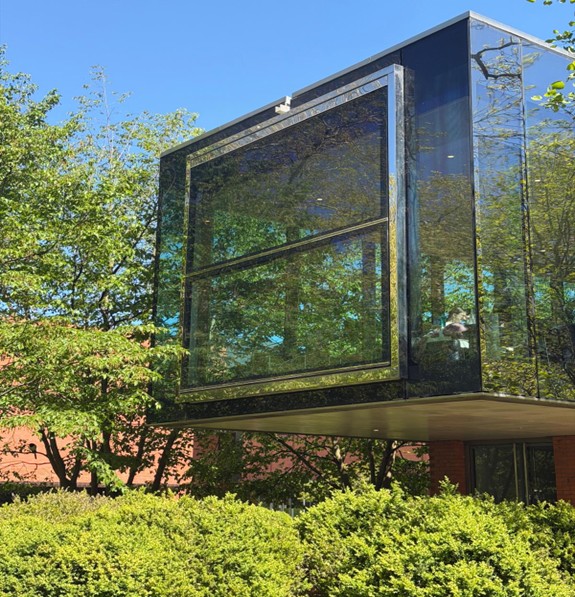
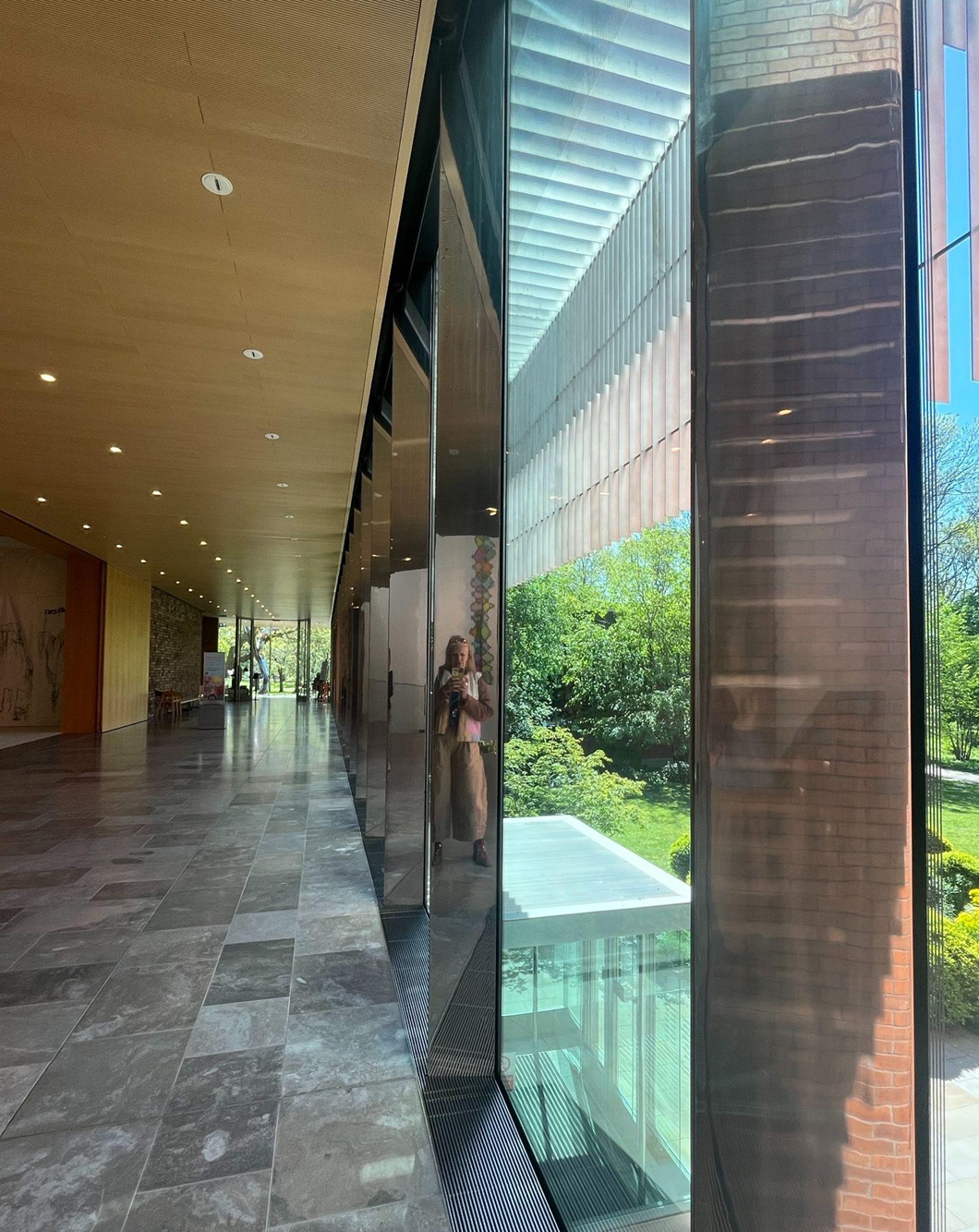 In this picture, we see a long corridor flanked with walls of glass on one side, pillars of mirrored glass at fixed intervals, straight lines, boxes… There will be many who gain comfort from the linearity, who understand and feel safety from structure, where the order of the walls is akin to the mapping out of a project plan which sets out a clear pathway to research success – the metric. After all, fixed lines provide clarity – the route is mapped out before us.
For me, however, I entered the hallway and was captivated by the movement even within such order and structure. I could see how movement was part of the process of co-creating the space: the human and more-than-human insert themselves by changing the light and shade, casting shadows and introducing new colours and textures, creating messiness, new tones, and new imagery.
For me, the success of my research emerges through that messiness – we have the structure and order (proposal / plan / budget) but co-creation is where the possibility lies. The researcher is in a constantly moving and shifting relationship with the research because the context changes, relationships, goals, hopes, imaginations all change.
Photo 2:
The cafe at the Whitworth is a special place: taking time for a hot cuppa sitting nestled among and warmed by the dapples of sunlight cast through the branches is something to be treasured.

As I sat below, I imagined the metrics of success that the architect and designer of this space must have, at one point, had to consider: just how much of an increase in visitor numbers? Was there an increased revenue for the cafe? But this is a gallery, a place that wants us to take those moments, so I also wondered how they captured the impact on those who go to that space for the freedom of feeling they were sitting in a treehouse? How do you measure the impact on someone’s connection to nature or how far their imagination was inspired and what they did with that inspiration?
Taking this image from outside looking in and up so I could capture the people inside the cafe through the trees was intentional. It spoke to me of what we foreground and make visible, and that which is less obvious, hidden, and nestled beyond. In research, the intentional decisions about what to foreground and to amplify as we share our work sit in a wider academic- knowledge- creation system that has already decided what counts. As researchers and research-adjacent workers, we have a collective task to pull back the canopy and reveal the possibility beyond.
The relational board
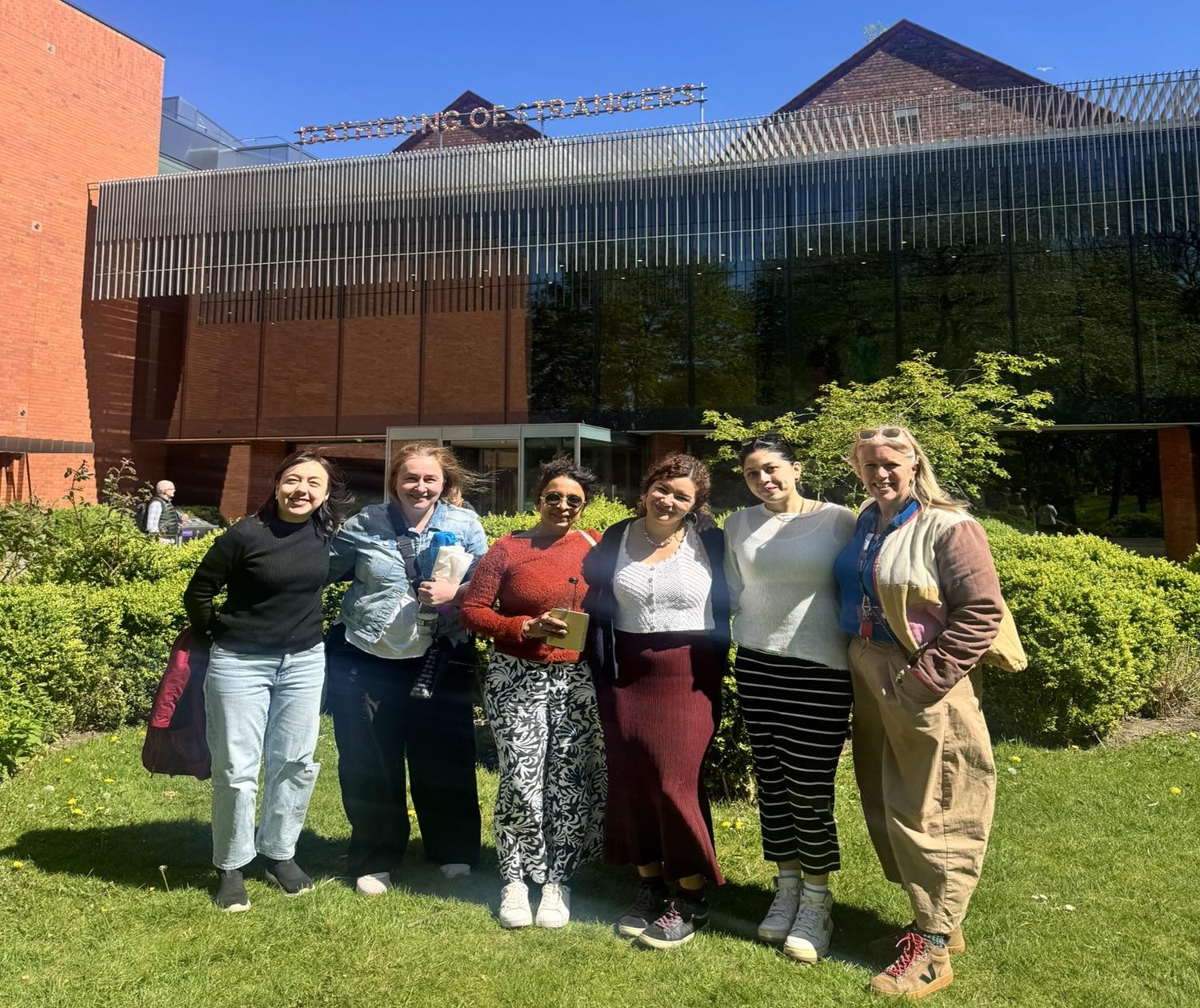
The team behind this piece during the workshop
After lunch, we built a relational mapping board, a simple method to make visible what research metrics overlook.
Three zones:
Yellow at the top for what institutions measure.
Green in the middle for what actually holds the work together.
Pink at the bottom for what gets lost when you report upward.
We pinned our notes. Stepped back. Discussed threads between them. Then stood there for a while, looking and reflecting. Patterns that emerged across our relational board:
- Metrics: Funding · Innovation · Publications · Scales · Gender
- Relational values: Agency-Governance · Solidarity-Empathy-Collaboration · Support · Rootedness · Trust · Long-term Impact · Partnerships
- What got lost?: Time · Emotions · Recognitions · Local knowledge · Experiences
Official reports act as a membrane. They let certain things through (numbers, outputs, deliverables, findings) and hold others back (the meal, the argument, the year before trust existed, the moment something shifted). All six of us have spent years pressing our work against this membrane, watching what survives the passage and what does not. The board we built at the Whitworth was an attempt to see both sides at once.
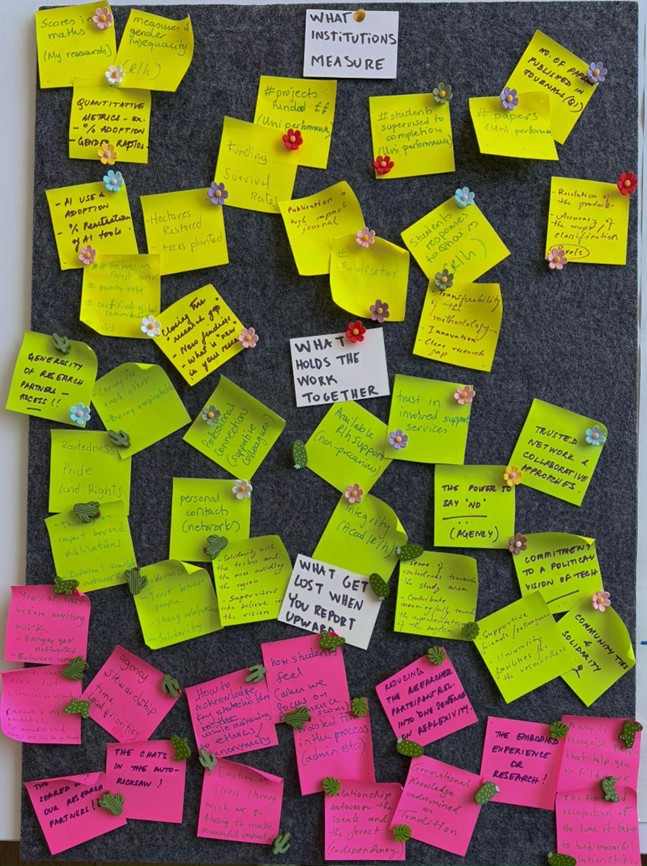
The relational board
What we saw
Five threads ran across the board, connecting research that shares no literature, no methodology, and no geography.
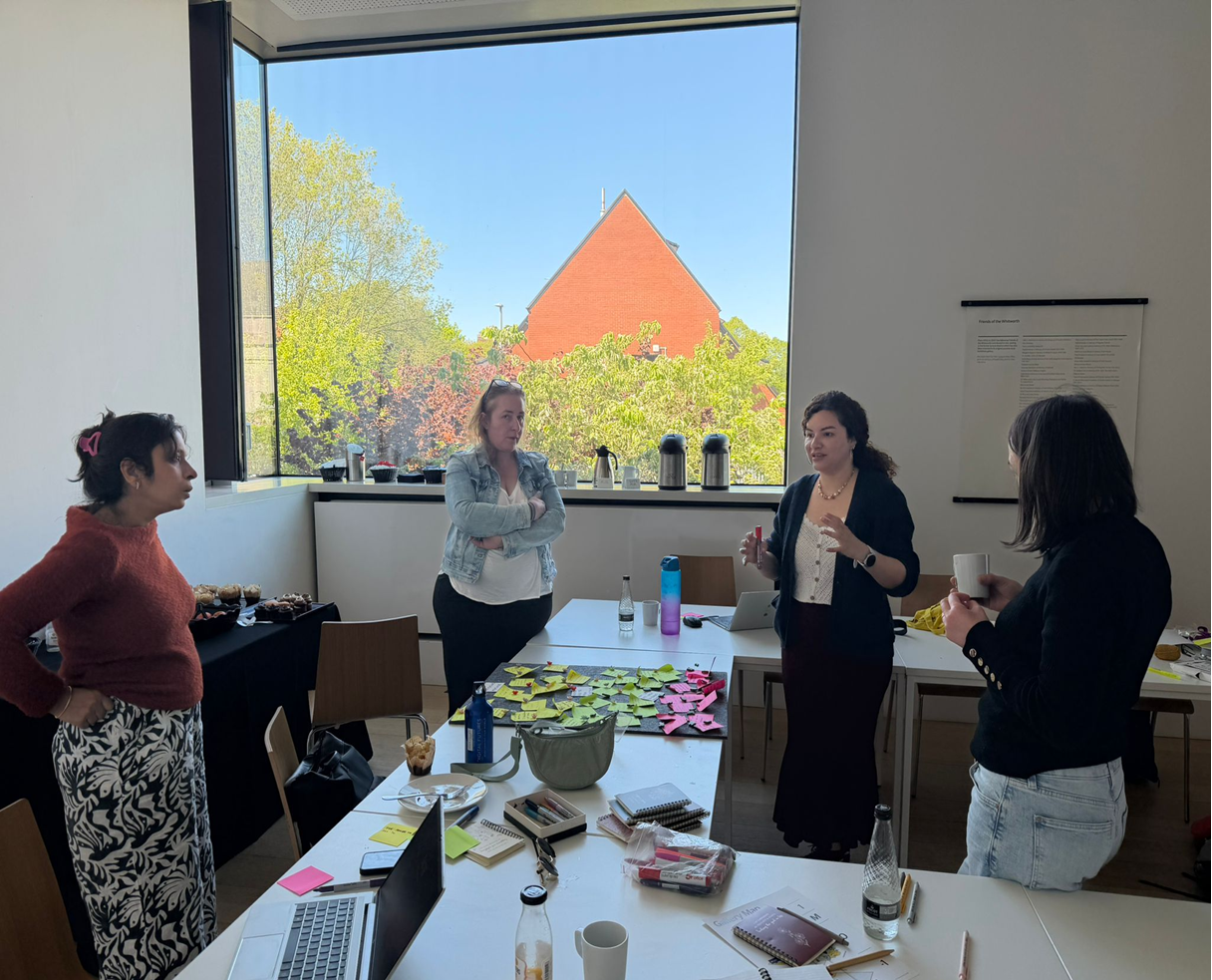
Afternoon discussions with the group
Time. It appeared in almost every pink note. Every relationship that holds research together takes longer to build than any reporting cycle allows. Mariana’s communities need decades of trust and rootedness for restoration program work. Sandra’s solidarity with grassroots organisations builds over years of shared struggle. Krishna’s forests operate on generational timescales that a single satellite overpass cannot capture. Maria’s students need sustained attention across terms, not interventions measured in weeks. Helen’s work in Lebanon highlights how unexpected external forces can require us to shift expectations and timescales, always prioritising the ethics and principles that guide the “what” and “how” of our work. The board made it visible that relational research is structurally penalised by the temporality of institutional assessment.
Emotions. The pink zone was thick with feeling. The doubt, the care, the frustration, the imposter syndrome sitting alongside the work. Maria named this openly. We tend to frame these as personal, peripheral to the research itself. The board suggested otherwise. They are part of their infrastructure.
Recognition, or its absence. Several notes circled the same problem from different angles. How to acknowledge stakeholders when ethics protocols require anonymity. How to recognise people who help you with fieldwork. The generosity of research partners – the meals, the open doors, the shared knowledge – all of it compressed into a line in the acknowledgements or erased entirely. Sandra wrote that all that time, energy, emotion, and connection poured into making research happen is suddenly erased the moment we write about it. The formats through which we report research have no field for reciprocity.
Local knowledge. Krishna asked whether advancing technology is really progress if the knowledge of people who have lived with these landscapes for generations is still filed under ‘tradition’ rather than counted as expertise. Mariana’s work shows how arraigo and generational ecological knowledge determine restoration outcomes far more reliably than any policy instrument. Anuradha found that the informal systems platforms replaced were simultaneously exploitative and supportive, and the platform kept neither function. Across disciplines, the board showed that the knowledge systems institutions value least are often the ones research depends on most.
Experience. The embodied, lived, sensory reality of doing research. The chats in the auto-rickshaw. The dancer tree outside the museum. The walks through community forests. The conversations that shaped our understanding in ways no methodology section can hold. Anuradha asked the question that sat at the centre of the board. “How do I remain accountable to these experiences as a person?”
We came to Whitworth as six researchers with almost nothing in common. We left understanding that what holds research together lives not in any one of us, but between us, between our work and the communities it depends on, between what institutions count and what actually matters.
What would your work look like if you measured what actually sustains it?
We left with a shared conviction:
If success depends on relationships, then the way we measure success needs to change.
Relational Futures was organised by Mariana Hernandez-Montilla (Global Development Institute) and funded by the SEED Social Responsibility Fund, University of Manchester. The authors thank the Whitworth Art Gallery for hosting, and all the research partners, communities, students, and colleagues whose relationships hold this work together, even when the reports cannot say so.
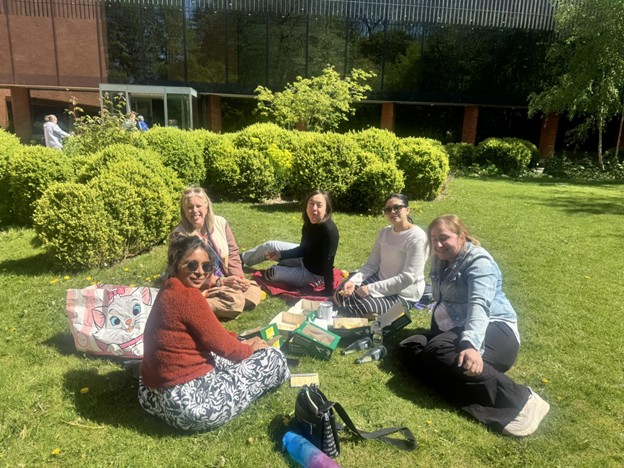
Reflecting on the importance of human connections
Note: This article gives the views of the author/academic featured and does not necessarily represent the views of the Global Development Institute as a whole.
Please feel free to use this post under the following Creative Commons license: Attribution-NonCommercial-NoDerivatives 4.0 International (CC BY-NC-ND 4.0). Full information is available here.