
by Sammi Dé, Fourth Year Undergraduate at the Global Development Institute
I recently read Arundhati Roy’s new memoir, Mother Mary Comes to Me, in which she seamlessly blurs the lines between deeply personal details of her life and the wider political environment surrounding them. The style emulates that of her novel, The God of Small Things, where individual experiences are again consistently bridged with world-historical processes. As the title suggests, her prose assumes the task of reconciling the Small with the Big.
I think her most distinct method of achieving this bridging is her unconventional use of capitalisation. In The God of Small Things, everyday phrases that hold significance to its young twin protagonists are often capitalised, granted the same weight as Big Ideas and institutions assuming proper noun forms. She begins the book with capitalised terms that underline the naïve certainty of the children’s perspective:
“In those early amorphous years when memory had only just begun, when life was full of Beginnings and no Ends, and Everything was Forever, Esthappen and Rahel thought of themselves together as Me, and separately, individually, as We or Us.” (2)
These are then intertwined with increasingly abstract and external political elements that begin to pervade the children’s lives:
“Edges, Borders, Boundaries, Brinks and Limits have appeared like a team of trolls on their separate horizons.” (3)
And
“She presided over the World in her drawing room on satellite TV… She was frightened by the BBC famines and Television wars that she encountered while she channel surfed. Her old fears of the Revolution and the Marxist-Leninist menace had been rekindled by new television worries…” (28)
In these two quotes, capitalisations appear as a way of representing Big Ideas. Abstract notions, external to the children’s immediate lives, like Revolution and Borders, are placed on equal ground to the more naïve, subjectively constituted ones like Forever and Everything. Both sets of notions (the Historical, the personal), are thus experienced with the same emphasis, their usual typographical division is destabilised.
Isla McKetta notes how, in capitalising earlier naiveties, Roy is demonstrating “the weight of a mother’s emphasis” in a child’s early life, how, through the child-parent relationship, false certainties take their form. As the children grow, a number of other external notions come to bear that same false certainty, that officialised status of capitalisation. Increasingly these are ideas provided by the external world, beyond the mother. Again, as underlying givens in the children’s minds, they are capitalised.
When, throughout the book, these Big Ideas are put into contact with the bodies and spaces of her stories, they are rendered absurd. For me, the illusion of certainty provided by capitalisation here seems to represent a foundational element of Roy’s critique; she is charging established notions/norms with an internal irony. If you’ve managed to bear those few paragraphs of literary analysis, I think there is a valuable implication here when she deploys this critical approach against development studies (or, perhaps I should say, Development Studies).
The Narmada Valley Development Project
In her 1999 essay, The Greater Common Good, Roy criticises the Narmada Valley Development Project, a mega dam-building initiative along the Narmada river in central India. Her piece focuses primarily on the construction of the Sardar Sarovar Dam, a project funded by a partnership comprising the Indian State, regional State governments and the World Bank. The scheme was projected to displace hundreds of thousands of local inhabitants, flood native tribal lands and replace ancient water management systems with a centralised form that gave more power to the State to dictate where and who had access. For these reasons among many more it was met with widespread resistance, predominantly through the Narmada Bachao Andolan movement initiated by native tribes, and supported by farmers and activists, including Roy herself.
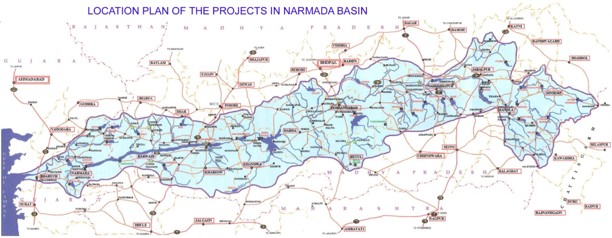
Plan of Water Resources schemes in the Narmada Basin (1995) Nvvchar: Creative Commons
The contest regarding the project’s approval grew bigger than the project itself, becoming the cornerstone of a national debate around modern statecraft, tradition, and other contradictory logics of postcolonial development. Due to the Narmada’s scaled-up discursive importance to the Indian Developmental State, the outcome and response of this local resistance, she explains, became subject to the “one voiced” whims of an abstracted national discourse.
A struggle against the dispossession of ancient ancestral lands came to represent a far more abstracted war, one between ‘Development’ and ‘Anti-Development’, between Nehru’s Modernisation and Gandhi’s village-centred vision. Big Ideas projected onto a local specificity. For the potentially displaced peoples,
“the fact that the stakes were raised to this degree has meant that their most effective weapon- specific facts about specific issues in this specific valley- has been blunted by the debate on the Big issues.”
In deploying the same literary mechanism, this time in a real historical battle, Roy is not only critiquing the Sardar Sarovar Dam, but the logics of scale and abstraction that underline it:
“The millions of displaced people in India are nothing but refugees of an unacknowledged war. And we […] are condoning it by looking away. Why? Because we’re told that it’s being done for the sake of the Greater Common Good. That it’s being done in the name of Progress, in the name of National Interest (which, of course, is paramount).”
The irony employed here is forceful, yet simple. By employing the same capitalisation devices as in her novels, Roy highlights the absurdity of a dynamic where a national developmentalist discourse, notions of “Progress” and “National Interest”, are made to confront the realities of displacement, enclosure, and the erasure of a people’s history- where Indians are implored to accept forced dispossession in the name of a scaled-up, state-manufactured sentiment of a Greater Common Good.
Beyond mere technical consistency, then, Roy’s critical device is describing the Project’s uneven topology of power. She is commenting on the ways in which Indian statecraft is exercised through unequal hierarchies of scale, justified through abstracted discourse and tainted by vested institutional interests. She is critiquing the ‘Big’, by dissecting the confrontation between the grand State narratives that hold ideological weight and the (less neat) realities of those whom they supposedly operate for.
This also presents as postcolonial critique: Roy is appropriating that Enlightenment philosophical narrative form associated with universal claims for a postcolonial setting historically subject to their imposition.
Sound familiar? As a student of development, it did to me. The Global Development Project: a big D born out of Big (Colonial) Ideas and structured by the Big Institutions that execute them. (For some, reconciled by the small (d).)
In the essay, Big Dams thus come to represent Big Ideas, the material culmination of the ‘big D’ developmentalist imaginary: “The Narmada Valley Development Project is Big”. Roy traces such logic back to Nehru’s modernisation discourses, which described dams as the “Temples of Modern India”. In her argument, the Dam is this discourse made material, a product of Big, hegemonic statecraft. She states:
“Big Dams are obsolete. They’re uncool. They’re undemocratic. They’re a Government’s way of accumulating authority… Big Dams haven’t really lived up to their role as the monuments of Modern Civilisation.”
High Modernist statecraft
Her critiques reminded me of James C. Scott’s in Seeing Like A State, a study of failed development schemes, where he discusses the necessary abstractions a developing State must make in order to establish formal order and top-down control. This involves an examination of the logics of High Modernist planning: “a particularly sweeping vision of how the benefits of technical and scientific progress might be applied- usually through the state- in every field of human activity” (90). High Modernist schemes involve the simplification and rationalisation of spaces and populations, culminating in a bracketing of local context that appears necessary for large-scale, ‘scientific’ development.
One of his examples is the construction of Chandigarh, the capital city of Punjab. Commissioning Le Corbusier, the master architect of High Modernism, Nehru’s vision for the city was a design that “presented Chandigarh’s [prospective] citizens- largely administrators- with an image of their own future” (132). Like the Narmada Dam Project, Chandigarh followed the technological vision of the Modernising state and the new Indian elite: “On the ground, the scale is so large and the width between meeting streets so great that one sees nothing but vast stretches of concrete paving with a few lone figures here and there” (131). Here, like the Dam, concrete appears as a primary tool.
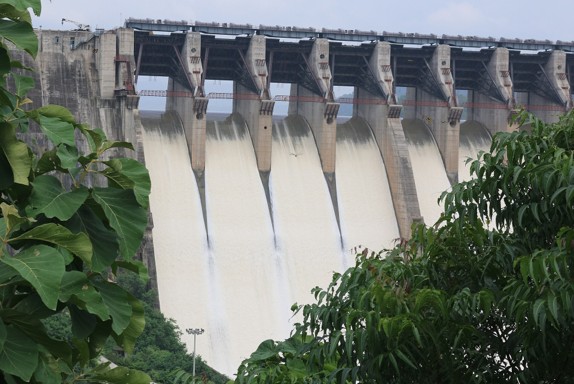
The Sardar Sarovar Dam is the second largest dam in the world in terms of volume of concrete used in its construction. Rupeshsarkar: Creative Commons, 2016
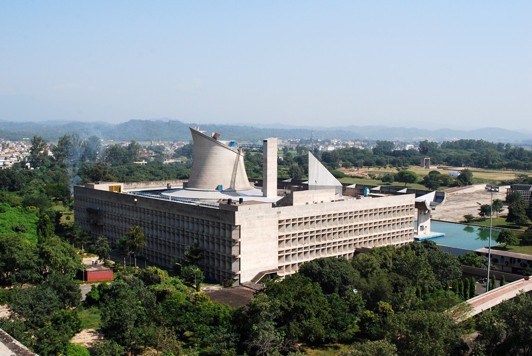
Le Corbusier’s Palace of Assembly in Chandigarh, Sanyam Bahga: Creative Commons, 2006
For Scott, High Modernist planning like this often serves to obscure an underlying project of State expansion: the accumulation of a population rendered legible to the eyes of an expanding bureaucracy. Roy is similarly sceptical over the state-making project of dispossession that lies at the foundation of Big development projects:
“How can you green a desert, or fell a forest and plant one somewhere else? You use caprice to fracture a people’s faith in the ancient things– earth, forest, water, air. Once that’s done, what do they have left? Only you. […]
You are their mother and their father. You are the judge and the jury. You are the World. You are God.”
Through force the State establishes a despotic grip on reality. Like the mother asserting false certainties to her children in Roy’s novel, it comes to assume a Truth-making authority and a constructed dynamic of dependency. The State becomes their “mother and father”, their “judge and jury”, their “World” and their “God”.
Throughout Scott’s book an uneven development topology is solidified, asserting that “only those who have the scientific knowledge to discern and create this superior social order are fit to rule in the new age” (94). The echoes of such thinking are clear in the discourse surrounding the Dam. And certainly, Roy’s analysis could have served as another pertinent example in Scott’s book: both sites are physical manifestations of a hierarchy of power, the product of the Indian State’s expansionist, High Modernist logics. Those, like Roy, who opposed the sweeping operations of Nehru’s “new age” were condemned as “Anti-Development… fuelled by an arcadian, pre-industrial dream”.
The Anti-Politics Machine
The mechanical forces of scientific rationality in Development were more closely applied to the dynamics of Global Development in Ferguson’s The Anti-Politics Machine. Using the case of the World Bank’s intervention in Lesotho– the Thaba-Tseka Project– Ferguson outlines how the Bank’s Report’s discursive abstractions serve to manufacture and justify their intervention. Diagnostic labels assigned to the Lesotho economy, like Less Developed Country, “aboriginal” economy, “peasant” society, and “national economy”, fix subjects in a ‘backwards’ time. In disregarding the structural-historical causes of poverty, a ‘solution’ is formulated within a field of intelligibility that licences further imposition by the Developing State.
Such violent “theoretical rearrangements”, he argues, should not be seen as accidental: they persist because they are necessary for the production of prospective sites for (‘big D’) “development” interventions- development institutions like the World Bank, holding exclusive Development Expertise, cannot reproduce itself without such homogenising practices. In presenting technical solutions to the conditions of those they seek to fix, questions of poverty are depoliticised. He identifies this process as the workings of an Anti-Politics Machine: a direct product of top-down discursive constructions.
Roy’s irony exposes the same process of abstraction, by the same organisation. She notes how the Bank’s initial loan for the Narmada Valley Project- a healthy 450 million dollars- was sanctioned with “the merest crumbs of information” regarding human and environmental costs. With a similar discursive trick, the question of displacing and resettling some of the oldest tribal societies of the subcontinent was converted into a calculation of cost: displaced peoples became what the Bank called PAPs- Project Affected Persons.
“They help, these acronyms, they manage to mutate muscle and blood into cold statistics. PAPs soon cease to be people.”
In the calculations of “Fascist Maths… [which] manages to blind perfectly reasonable people with its spurious, shining vision”, the displaced are a small side-effect. After being ground up in the Development Mill (this appears to be her name for the Anti-Politics Machine), complex realities become statistics “For Your Consideration”.
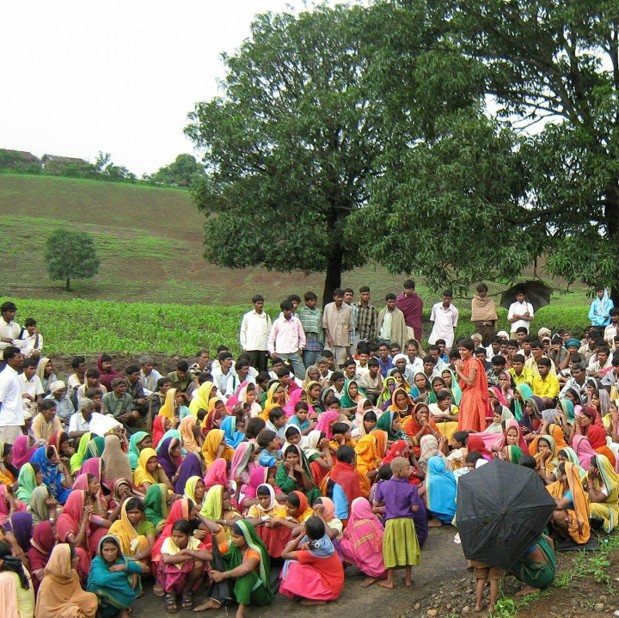
Meeting conducted by Narmada Bachao Andolan activist Yogini Khanolkar in the tribal village Pathali block Akrani District Nandurbar on forest rights issues, Nnnamaharashtra: Creative Commons, 2021
In becoming PAPs, victims of the Project became arrangeable, points to displace and re-place. The Gujarat State Government divided one tribal village into 175 scattered sites, smashing up genealogies, communities, social lives. One single rehabilitation site in Gujarat experienced nine deaths in a week.
“That’s 1.2875 PAPs a day, if you’re counting.”
Other forms of PAP management were similarly reductive. The State compensated for the erasure of the livelihoods of tribal people operating outside the money economy with cash transfers, which for them, brings “about as much use… as a Supreme Court judge has for a bag of fertiliser”. Forced integration into the market economy: what else could make sense but such a technical solution for a technical problem? What else but a Modern structure for a Backwards people? Most were stripped of their land, able only to sell their labour to survive. Displaced peoples, or PAPs once confronted with the Big, she explains, “had to learn to have Masters”. More dispossession, more accumulation.
Ferguson’s account therefore helps explain the mechanics behind Roy’s critique of the “Big” here. Roy’s irony exposes what happens when abstract developmental categories like PAPs collide with the specificities of a river valley, its inhabitants, and its history. Roy’s “Big Ideas” become, in Ferguson’s terms, the theoretical rearrangements through which violent intervention processes are justified. Money is given to non-money people. One community becomes 175 points on a planner’s map.
Since India’s independence, the conservative estimate of those displaced by Big Dam Projects-swept away by the torrents of Modernisation- is 40 million. Still, such estimates are scaled-up abstractions, and most aren’t even graced with the senseless memory of a statistic.
The Development Apparatus
Ferguson’s central target in his critique is what he calls – in capitals – the Development Apparatus. He condemns the vested interest that arises in profit-seeking development organisations like the World Bank where risky and under researched financing opportunities in fragile locations are incentivised, disguised in the form of aid (like the IMF’s SAPs). To reproduce itself, the Bank exports “pre-packaged development”: technical solutions that follow the interests of the bureaucracy. In Lesotho as on the Narmada, “unhelpful” analyses are banished, while ones that posit potential sites for development are promoted and funded.
“Development agencies are in the business of trying to “sell” these packages, trying to locate and justify potential applications for the. As [Judith] Tendler has shown, a prime institutional need of the agencies and the bureaucrats is to “move money”.”
Roy similarly highlights how, in the case of the Narmada, corporate interest and the Development Project tend to go hand-in-hand. Why was the World Bank so keen to accept the loan proposal, that they sanctioned the Project two years before India’s own Ministry of Environment? The dam-building industry, she argues, has been “exported to the Third World in the name of Development Aid”. Aid, in this case, acts as “just another praetorian business enterprise. Like Colonialism was.”
She traces her critique through the messy layers of bureaucracy involved in such a process:
“In the Development racket, the rules are pretty simple. If you get invited by a Government to write an EIA for a Big Dam project and you point out a problem (say, for instance, you quibble about the amount of water available in a river, or, God forbid, you suggest that perhaps the human costs are too high), then you’re history. You’re an OOWC. An Out Of Work Consultant. And Oops! There goes your Range Rover. There goes your holiday in Tuscany. There goes your children’s private boarding school. There’s good money in poverty. Plus Perks.”
Here, perhaps with slight hyperbole, but her most punchy ironical force yet, she ridicules the layering of interests that intersect within a Development Project like the Big Dam. The chain-effect she outlines is a clear contradiction at work in the operations of environmental or ESG consultancy agencies employed by international organisations. Roy is targeting the Apparatus, the ridiculous profiteering that begins with the Big Dam industry and ends with the ESG consultant’s Italian holiday.
Emphasis is made on the powers-that-be through capitalisation: Nation Builders and Publicity People, Bankers and Project Consultants working for the Centralised State. Through these uncanny capitalisations, Roy is ridiculing the professionalised status of the Development Experts, those who are convinced they have the knowledge to rule and operate over the developing masses (what Timothy Mitchell called the Rule of Experts).
Like in Ferguson’s critique, then, she is confronting the officialdom of the Development Apparatus, with its internal mechanisms of bureaucratic power.
Following the widespread resistance to its construction pioneered by Narmada Bachao Andolan, the World Bank commissioned an independent review of the “human costs” of the dam project, the first of its kind in the Bank’s history. The Morse Report recommended that the environmental and human impacts of the project were not adequately addressed or considered prior to the Bank’s loan, and that the “failure of the bank’s incremental strategy should be acknowledged”. This marked the first time the World Bank had withdrawn funding from a project. Despite the strength of the report, it was, first and foremost, the Narmada Bachao Andolan struggle that initiated the Bank’s withdrawal. The Expertise arrived long after the local recognition that something was very wrong. The story must primarily be a testament to the radical action of a people resisting State violence, one that, through the persistent struggle of peoples and organisations like Narmada Bachao Andolan, continues to this day.
The Century of the Small
What, then, can Roy’s essay offer us, at the institutional, ‘Expert’ end of the Development Apparatus? What responsibilities do we have in acknowledging our discipline’s violent histories? And how might we reimagine the hierarchies that enable them to persist?
Roy speaks of the potential for the dismantling of the Big: “Big bombs, big dams, big ideologies, big contradictions, big countries, big wars, big heroes, big mistakes”. Instead, she proposes, we ought to “support our small heroes… we have to fight specific wars in specific ways”. This potential transformation of our developmentalist thinking is situated within a new historical time she calls the “Century of the Small”. Resisting Big Ideas, then, through a return to the small, or more directly, a transformation in the way we conceptualise and plan Development, from grand theory and top-down topologies to smaller heroes, smaller ideas, the coevalness of multiplicities and difference. A down-sizing of scale and institutional hegemony where Experts no longer sit in ivory towers, surrounded by their clouds of Ideas. Where people are heard, and listened to.
It is clear that Roy’s critique is closely aligned to the post-development thought recently emerging in development studies, grounded in an array of sovereignty-focused approaches like bottom-up and ‘small d’ development, participation and pluriversality. With Roy’s indictment, however, we are well positioned to ask: is such a radical move away from big institutions like the state and the international development apparatus truly yet intelligible within our discipline (and are ‘participatory’ projects not merely a more digestible step towards this radical break)? Does such decentralised practice yet exist to any considerable extent in the dominant discourse, and what can the limitations of such “small thinking” becoming the norm tell us about the wider dynamics of the academy and its structural dependencies? And, further, how do these dependencies shape the frameworks of our knowledge-production?
In understanding these structural limitations we ought to remain constantly sceptical of the institutionalised buzzwords that this “century of the small” has provoked.
Roy’s essay is an important reminder of the contradictions inherent when the Big enters and operates within the small, like the Apparatus in a river, the Publicity People against a self-reliant tribal civilisation. She is not asking us to simply choose one over the other, but rather, to be constantly aware of who has the power to define the terms of these ‘Development’ encounters. For a discipline like ours, accustomed to abstractions of scale and categorisation, Roy forces us to question what disappears, and what is excluded, when the Big enters and confronts far more complex realities.
I think, finally, that her literary force is testament to the potential power of prose, poetics and subjective narrative to shape the ways through which we describe and critique development practice.
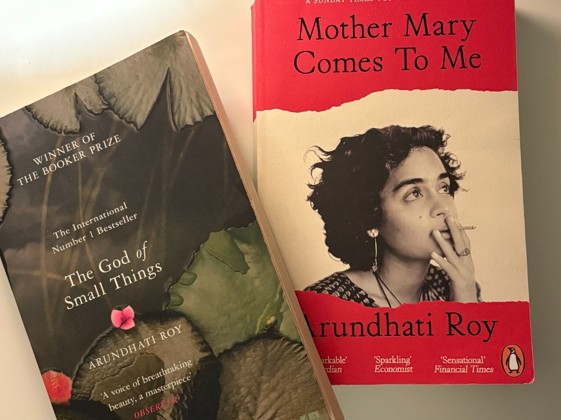
The God of Small Things and Mother Mary Comes to Me (author’s picture)
Keen to read more of Sammi’s reflections about Development Studies, politics, and everything in between? Do check out (and subscribe!) to his Substack.
Note: This article gives the views of the author/academic featured and does not necessarily represent the views of the Global Development Institute as a whole.
Please feel free to use this post under the following Creative Commons license: Attribution-NonCommercial-NoDerivatives 4.0 International (CC BY-NC-ND 4.0). Full information is available here.