
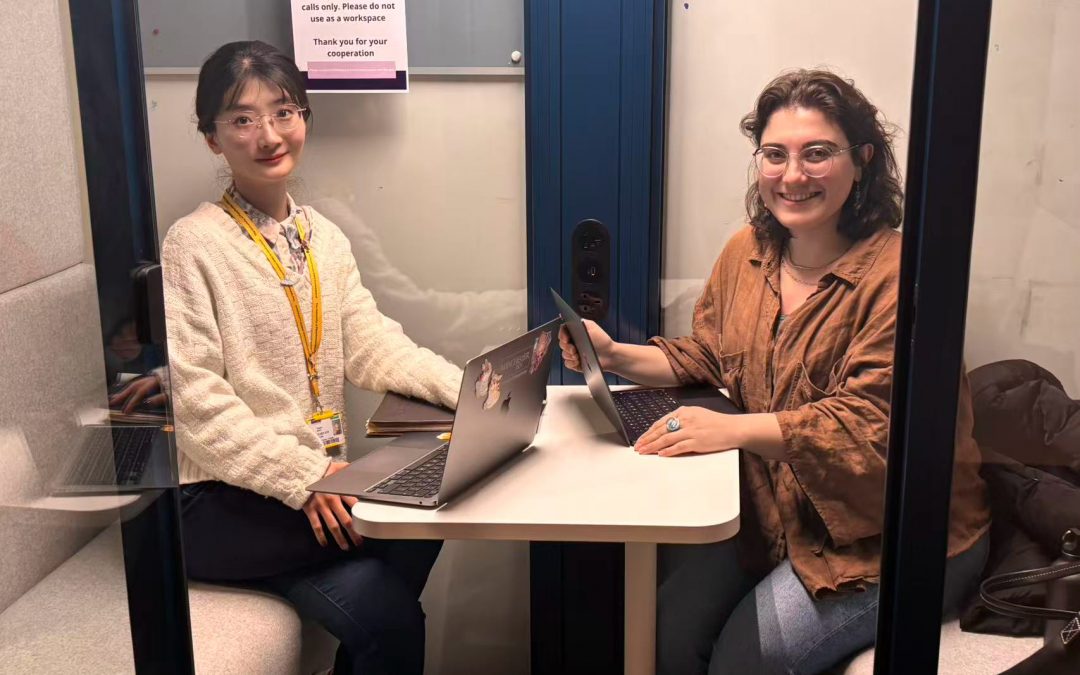
By Yingqian Wang and Jiaxing Shao
Funded by GDI’s Innovation Fund, Flux is a podcast that takes a deep dive into life after graduating from a master’s programme. In this blog, the podcast’s creators and hosts, Yingqian Wang and Jiaxing Shao, discuss their reasons for starting the podcast, the kinds of conversations they enjoyed during recording, and how lecturers and students can make the most of the episodes.
When you’ve handed in your master’s dissertation, it’s only natural to ask yourself: “So, what’s next?” Here’s what some GDI graduates told us about their first moves into the workplace:
“As a student, I felt I had room to make mistakes and could ask my lecturer for more time when I needed it. That changed when I started work – I suddenly realised that there was no student buffer anymore.”
“I know something about what this job looks like, but I don’t know its responsibilities.”
“I have the skills the recruiter mentioned. I just don’t know where I can use them.”
We were watching friends finish their degrees and start work. We heard where they had landed, but we wanted to know how they were getting on: What was it like to speak for an organisation for the first time? How were they coping with the pressures of a new job? And how could we, as educators, better support them as they moved into work?
End-of-term surveys usually ask students to rate their experience while they are still on the programme. By the time a graduate has something to say about becoming a colleague, managing a team or feeling out of their depth at work, the survey has long since closed. We wanted to hear those personal stories. A relaxed conversation, in a language each guest felt comfortable speaking, seemed a good place to start.
That’s why we started Flux, a podcast series about life after graduation. Over the past year, we’ve recorded eight conversations in English and Mandarin for our first season. We had two groups of listeners in mind: students and recent graduates wanted to know where people who took their course had ended up and what advice they could offer, and lecturers and programme teams. The question was what we could learn from those experiences to better support the next cohort.

For students and recent graduates exploring their options
Former students told us they would have welcomed advice from earlier graduates while they were doing their master’s. In particular, they wanted to know what people with the same degree actually did at work. We chose guests who had taken different routes for that reason. Across the series, you can hear what it’s like to start a business, pursue research, work for an international organisation or join a private company. Even the three conversations with digital development graduates take you into quite different workplaces: a software company, a product training session and the production of a live concert.
Once a role catches your interest, the next question is how to find a way in. Our guests share how they found a way into their desired industries. For example, some reached out on LinkedIn to people already working in the field. Others asked a classmate to introduce them to someone in the industry. Graduates also talk about how the University’s Careers Service helped them apply for work for the first time.
All eight guests are happy to continue the conversation. If several readers are interested in the same career path, we may organise an online panel with alumni working in that field. To speak with a guest or express interest in a panel, please email the Flux team at yingqian.wang@manchester.ac.uk.
For lecturers and programme teams
Hearing how graduates found their way into work also gave us a chance to ask what might have helped them earlier. So, in the final part of each episode, we turned the conversation back to the master’s programme. What would they change about the course? If they could take it again, knowing what they know now, what would they most want to learn? Their suggestions varied depending on the work they had gone into, but certain themes kept emerging across our conversations. Here are two examples:
- Show students how their learning connects to work from the start of the master’s. On a one-year programme, students often choose modules before they know what different jobs involve. Several graduates said they would have welcomed guidance at that point. Hearing what former students did in their jobs would have helped them decide which modules would be most useful for their own career plans. Once a module begins, lecturers can keep that connection in view by showing how a method applies in different career settings. One graduate gave an example of stakeholder analysis. He only recognised how the model applied to his own work when he began working with dealers and retail staff. Had he seen that connection in class, he felt he would have paid closer attention to methods he could use beyond his degree.
- Teach students how to collaborate with AI. AI came up both in accounts of job interviews and in descriptions of everyday work. It is also blurring some of the boundaries between roles. Someone who understands a problem in their team may now be asked to help build a tool to solve it, even if software development is outside their original training background.
One student described the course they most wanted to take: learning to build software with AI, starting with no coding experience. They wanted to learn from a lecturer who, like them, had started with no coding experience and had learnt to build software with AI. Someone with that background could teach them a method they could use in their own work: how to break a problem into smaller tasks, explain to the AI what each task requires and check whether the software they built with AI does what they need it to do. The aim was learning to use AI as a partner.
These examples give a sense of what graduates would like programme teams to consider. In the podcast, each graduate tells their own story of moving from study into work. You may hear something that makes you think differently about your own next step or about a course you teach.
Want to hear the whole story?
- Alicia. Alicia turned down a job in China to work on environmental programmes with the United Nations Development Programme in Africa. She talks about finding her voice in an international team and learning to communicate with colleagues from different backgrounds. This episode is in English. Listen to Alicia in Starting Work, I Found the Key Skill Isn’t in Textbooks
- Yi. Yi spent a year as a research assistant before starting a PhD. She took the job to find out whether a career in research would suit her. What surprised her was how much of the working day involved responsibilities beyond the research itself. This episode is in Mandarin Chinese. Listen to Yi in Speak Less, Listen and Observe More – It is My Workplace Survival Rule
- Hiroto. After working with farmers in India and studying in Manchester, Hiroto spent two years with UN-Habitat in Kenya, working on urban development. He describes the shift from speaking as a student to representing an organisation in discussions with local government and businesses. This episode is in English. Listen to Hiroto in My Name Means “Hero”, and I Want to Change the World
- Zihan. After studying human resource development, Zihan set up a study-travel business. Persuading more experienced people to trust a young founder was one challenge. Trusting them enough to hand over decisions was another. This episode is in Mandarin Chinese. Listen to Zihan in 7AM to 11PM, Seven Days a Week—I Leave No Room for Life, to Seize Every Opportunity Given
- Berna. Berna worked as an IT business analyst in Türkiye before coming to Manchester. During her degree, she spent three or four weeks on an assignment that asked her to define a problem and propose a software solution. Later, as a product owner, she had a week to do much the same thing, this time for colleagues who had different ideas about what they needed. This episode is in English. Listen to Berna in Back to School After Work, I Learn More Purposefully
- Jerry. For this episode, we invited Jerry, a member of the Flux production team and a Manchester graduate, to share his own story. After completing his master’s degree in digital development, he became a product trainer. Teaching overseas dealers and retail staff how to use imaging products brought together his interest in the technology and something he already enjoyed: explaining how things work. This episode is in Mandarin Chinese. Listen to Jerry in Growing Into Work Means Growing Out of the Self
- Giselle. Giselle was still job-hunting when we recorded. She had gone into an internship at SAP interested in working for a technology company. Once there, she found that the part she enjoyed most was talking to people. That helped her narrow her search to roles in sales, product and operations. This episode is in English. Listen to Giselle in The Journey After Graduation When Finding Yourself Truly Begins
- Bingxin. Bingxin took a digital development degree into the live music business. When we asked Bingxin what she loved about the job, she described the days when a show was in production and she was so absorbed in the work that she forgot the time. This episode is in Mandarin Chinese. Listen to Bingxin in The Best Career Is Doing What You Love
Flux was supported by the Global Development Institute Innovation Fund.
Note: This article gives the views of the author/academic featured and does not necessarily represent the views of the Global Development Institute as a whole.
Please feel free to use this post under the following Creative Commons license: Attribution-NonCommercial-NoDerivatives 4.0 International (CC BY-NC-ND 4.0). Full information is available here.