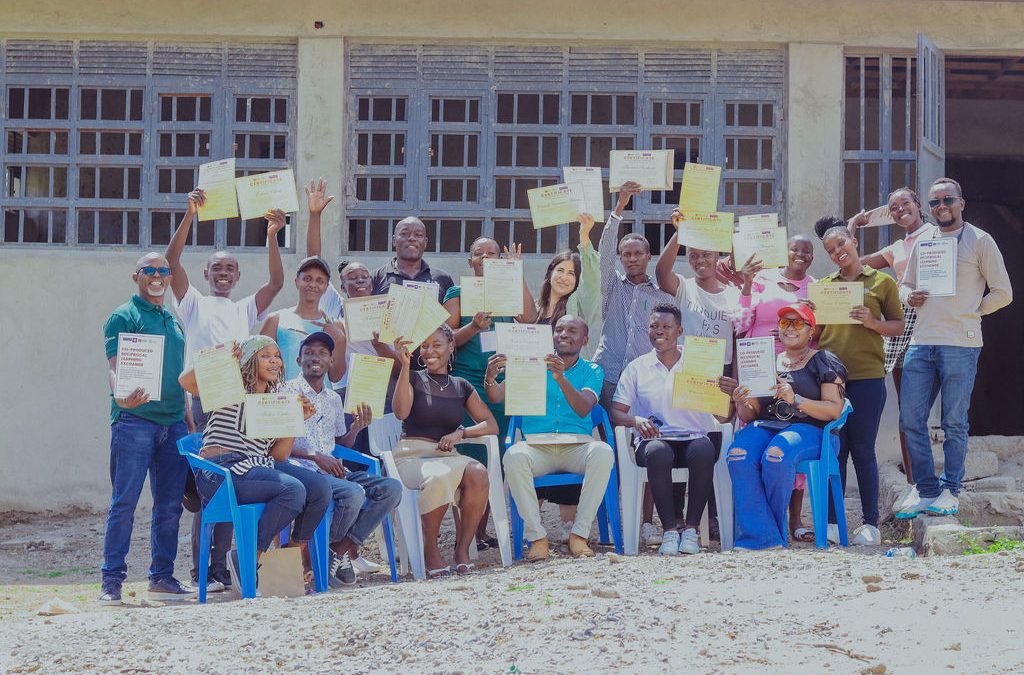
The Reciprocal Learning Exchange Project is a collective endeavour set up by the Muungano wa Wanavijiji Kisumu Federation and students from the Global Development Institute, supported by GDI’s Innovation Fund. Designed to better understand the benefits, challenges, and underexplored opportunities that come about when developing relationships between researchers and grassroots movements, the project involved several workshops to facilitate open exchange and reciprocal learning. The following blog details how conversations unfolded and is written collectively by everyone involved in the exchange. Fore more information about the individuals involved, please head to the ‘About Us’ section of the project website.
Written by Amber Wright, Camila Carrasco-Gomez, Daniela Cocco-Beltrame, Abraham Baraka Danda, Alexandra Molton, David Omollo, Dingling Wang, Ebony Thorogood, Emily Daniel, Joy Winnie Akinyi, Lewys Rees, Milka Sangare, Milly Jannaway, Monicah Grace Ochieng, Saumya Tiwari
Additional credit to the rest of the exchange participants: Daniel Byrne, Millycent Randiki, Evance Okoth, Carren Osomo, Hellen Oyuko, Victor Wandera Onyango, Kellier Akinyi Otieno, Thomas Sankara, Lizian Onyango
What was the project about?: Learning to exchange
Through the Reciprocal Learning Exchange, we came together as Muungano wa Wanavijiji (Muungano) co-researchers in Kisumu, Kenya, and GDI postgraduate students from the University of Manchester (UoM) to explore what a reciprocal relationship between grassroots knowledge and academic knowledge could look like in practice.
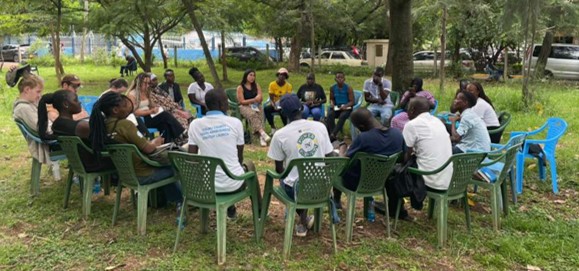
After some of us met on the fieldwork course in Kisumu, Kenya, for 12 days in March-April 2026, we were not ready to end our engagement with one another. Masters students Amber, Cami, and PGR Dani built on conversations with co-researchers and UoM peers to present a proposal to continue learning from one another. We applied to the GDI Innovation Fund in May 2026, and the project was selected for implementation.
.
The exchange built on GDI’s long-standing partnership with SDI and, more broadly, from conversations about how relationships between universities and grassroots movements might extend beyond short-term research encounters. From the outset, all of us were involved in deciding what we wanted to learn, what we could contribute, and how the exchange should operate.
The exchange began with the simple idea of recognising that every participant held their own valuable skills and knowledge to contribute to the exchange, regardless of formal qualifications.
Rather than beginning with an assumption that one group had knowledge to deliver and the other had gaps to fill, we started by mapping what people already knew. Collectively, we identified experience developed through research, community organising, professional work and everyday life, including communication, listening, networking, facilitation, data collection, mobilisation, teamwork and much more.
As Evance, a Muungano co-researcher, later reflected:
“The experience also helped me realise that my community experience is valuable knowledge.”
This became the basis for a reciprocal programme in which we, as Muungano co-researchers and UoM students, could both teach and learn from one another.
How did we work together?
The project began with a kick-off meeting to discuss the potential timeline and values that should guide how we worked together and what those values might mean in practice (see Figure 1, Figure 2).
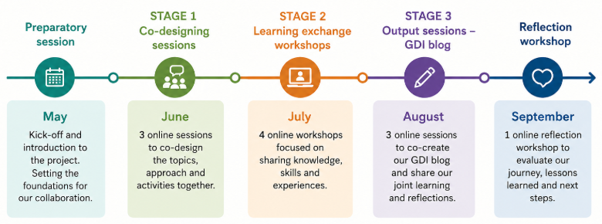
Figure 1 – Project Calendar
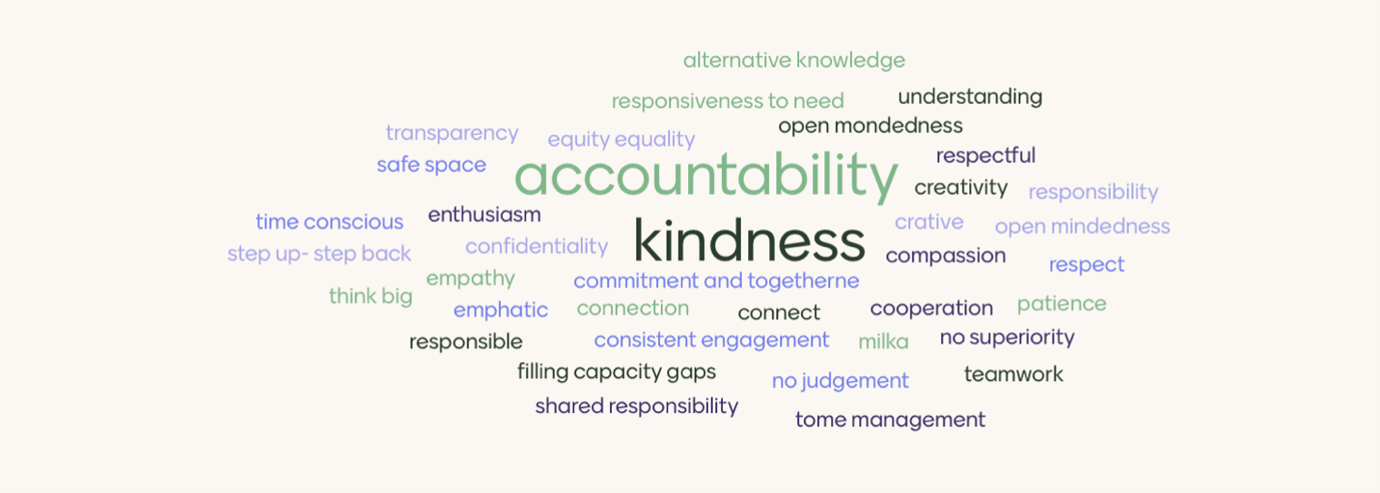
Figure 2 – Wordcloud of group’s values
This was followed by three co-design sessions. We first mapped the skills and experiences already present in the group (see Figure 3), identified what participants wanted to learn from each other, and collectively decided on the workshop topics and facilitators.
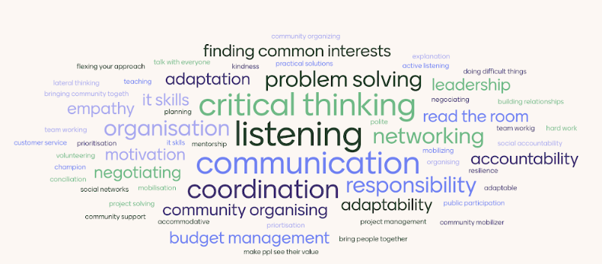
Figure 3 – Wordcloud of group’s skills
Co-design was not only about planning the exchange. It became part of our learning itself. Deciding together what to prioritise, who could contribute, and how the sessions should work meant learning how to communicate, negotiate, and make decisions together.
Together, we developed and facilitated eight workshops across four sessions, facilitated by both Muungano co-researchers and UoM students. Topics included community organising and women’s leadership, participatory research, questionnaire design, data collection and analysis, fundraising and grant writing, stakeholder mapping, advocacy, collective action and negotiation. We agreed that workshops should be practical and jointly delivered, with flexibility for participants to move between the roles of presenter and audience.
We shared our different experiences and approaches, from community sensitisation, enumeration, data validation, mobilisation and advocacy to research design, qualitative and quantitative analysis, proposal writing and communication.
Later sessions explored tools such as Kobo/ODK and community media through Know Your City TV, while the final workshops moved increasingly towards application, including using grant writing, stakeholder mapping, advocacy and negotiation exercises around issues we already encountered across our work.
Importantly, these roles were never fixed. We all moved between presenting, listening, facilitating, questioning and learning.
Milka, a Muungano co-researcher, reflected on discovering and practising different skills through this process:
“I discovered a lot of skills in myself, like research skills and communication skills. I learned how to present my ideas confidently in a mixed group, and how to manage time and work as a team even when we have different opinions.”
Reciprocity was not always straightforward
We do not want to describe the exchange as though calling it reciprocal automatically made it equal, because it did not.
The project was still funded through a university, and some participants carried more responsibility for organising meetings, administration and communication. We were working virtually across countries, work commitments, university schedules and different internet connections. Attendance changed from session to session, meetings sometimes had to move, and sustaining momentum over several months required much more coordination than we had initially expected.
For Dan, a UoM student, part of the learning came precisely from seeing that organisational process unfold:
“I learned how to organise these sorts of in-depth, proactive research projects, especially those covering diverse groups of people. I gained this insight from watching how the organisers adapted their organising over time, their communications and their use of different software to engage project members. I am looking to use similar tactics in my own industrial and community organising work.”
Participation also did not always look the same. Over time, we became more conscious that speaking quickly or frequently was not the only way to participate. Some people needed more time, different formats, or more deliberate invitations to contribute.
This made us reflect on how the format of the exchange shaped our participation. Working online, communicating across different languages, and bringing different levels of confidence and familiarity with academic spaces could all affect when, and how, people contributed. Rather than expecting participation to look the same for everyone, we had to keep adapting how we created space for a variety of voices.
Kellier, a Muungano co-researcher, reflected on becoming more conscious of this within her own facilitation:
“I have become more confident in facilitating meetings and creating space for different people to contribute. I now take a more active role in leading discussions, guiding the group through an agenda, analysing community data together, and encouraging quieter participants to share their views.”
These challenges were not separate from the exchange, but became part of what it taught us. Reciprocity, for us, required negotiation, patience, communication, and repeated adjustment.
Who gets recognised as a knowledge-holder?
One important learning was that any divisions between “academic knowledge” and “community knowledge” were not central to our approach. We know that Muungano co-researchers are already researchers, organisers, advocates, and facilitators, and likewise, University students brought experiences and skills developed beyond academic spaces.
But recognising that everyone brought valuable knowledge did not automatically make the exchange equal. We also had to pay attention to who felt confident presenting their knowledge as expertise, whose contributions were more easily recognised, and how existing power differences continued to shape participation.
This raised questions that became increasingly important throughout the exchange: Who spoke most? Whose experience was easiest to turn into a workshop? Which forms of knowledge were treated as expertise? Did association with a university still give some contributions more authority?
Muungano co-researcher Evance described one of the most significant changes for him as the confidence in recognising the value of what he already brought into the exchange:
“Through my interaction with the University of Manchester as a co-researcher, I had opportunities to speak, share my experiences and participate in discussions with people from different backgrounds.”
For us, reciprocity increasingly came to mean not assuming in advance who could teach, who could learn, or whose knowledge should frame the discussion.
What changed?
As the exchange progressed, we also began asking a more difficult question: So what?
It is relatively easy to say that participants attended workshops on data analysis, grant writing or advocacy. That does not tell us whether anything changed in practice. Importantly, change did not always mean learning something completely new. For some participants, it also meant recognising skills and knowledge they already had, finding words to describe them, and becoming more confident in using and sharing them with others. One example is data analysis.
Muungano co-researchers already gather extensive information through community research, surveys and enumerations. Our discussions therefore focused not only on collecting more information, but on how data could be organised, interpreted and communicated in ways that might support advocacy, reporting, grant applications and community decision-making.
As Hellen reflected:
“The engagement that we had gave us practical research skills and showed us how we can use evidence from our communities to strengthen advocacy and community action.”
For Abraham, that learning became tangible during subsequent work:
“Over the last couple of weeks I have been able to participate in a household survey on the River Kisat and River Auji environmental assessment, and I realised my approach was far better than before thanks to the learning we’ve had with UoM/Muungano over the last three months. My confidence was better, and I was also able to teach my fellow co-researchers about the tool that we used for data collection.”
Millycent Randiki similarly described how learning around facilitation and community-led research had already travelled into her work in Bandani:
“I have already used this in Bandani settlement in our Muungano savings group meetings. I now use the skills I gained to create safe spaces for women and youths to share and learn together. My confidence in organising and leading community discussions has improved.”
The same applies to facilitation, confidence, and participation. As we moved between learner and facilitator roles, we had opportunities to practise presenting ideas, leading discussions and making space for other voices.
Victor described a concrete change in how he now facilitates community meetings:
“I became more confident and knowledgeable in facilitating meetings with the aim of creating a safer space for different people to share their ideas. I have already applied this by taking a more active role in forming different settlement committees, with the chairpersons leading discussions and me helping to guide the groups through an agenda. This is meant to bring more participants on board and give them ownership in sharing their views, rather than centralising decisions around leadership views alone.”
Ultimately, for Milka, confidence also extended to representing her community in wider spaces:
“In my community work, I am now more confident to lead community dialogues. I use the mapping and data skills we learned to document issues in Bandani settlement. The project also boosted my confidence to speak in English in a professional setting and to negotiate ideas. I now feel I can represent my community in bigger spaces.”
For UoM participants, engaging with colleagues already organising around settlement data, waste management, savings, youth engagement, women’s leadership, climate change and community mobilisation also challenged assumptions about where expertise sits.
Emily reflected on how the exchange changed the way she thinks about research itself:
“I became more confident in thinking about research as a process, rather than just the results. During the exchange, we discussed questionnaire design and data quality using Kobo/ODK, which showed me how important it is to make sure research questions are practical and meaningful to the communities involved. I have applied this by thinking more carefully about how questions are designed, tested and adapted when I’m analysing or reading about studies and research.”
Not everything discussed needed to be adopted either. A research tool does not automatically strengthen community action, and a funding opportunity does not automatically align with community priorities. Part of reciprocal learning must also be the ability to adapt something, question it or decide that it is not useful.

What next?
We have now moved into the final outputs and dissemination phase, but we have been clear that this should not mean only producing material for a university audience.
Alongside this blog, we have created a website, podcast, and video. A subgroup is also exploring collaborative grant applications, putting learning from the fundraising workshops into practice.
During our final outputs meeting, we discussed ideas from Muungano co-researchers to use remaining project resources for further practical learning and dissemination within Kisumu.
Ideas included bringing the co-researchers together for an in-person reflection and practical analysis session, as well as holding activities within different settlements so that discussions and learning can travel beyond the twelve participants directly involved.
The discussion raised a wider question about what sharing power actually means. It means not only whose voice appears in a workshop, but who decides how resources are used, where learning is shared, who benefits, and who shapes what happens next.
Muungano co-researcher Millycent Randiki described continuation in practical terms:
“Going forward I will use these skills to train other young women and youths in Bandani settlement to lead their own savings groups, to support both UoM and Muungano in data collection, and to confidently represent my community in larger forums.”
Carren, a Muungano co-researcher, similarly emphasised sharing the learning beyond the original exchange:
“I have shared the skills with our young youths and women in Bandani and created a space for learning and sharing ideas together. My confidence in leading community discussions and organising has improved a lot. My community is happy, and I am ready to train more youths.”
These emerging outcomes suggest that continuation does not necessarily mean repeating the same exchange. It can also mean we carry particular practices, relationships, and forms of learning into spaces we are already part of. In this sense, continuation also happens when learning travels beyond the original group. We adapt our learnings, share them with others, and use them to strengthen work that is already happening in our communities and organisations.
What are we taking forward?
The value of the exchange was not that we discovered a perfect model of co-production. We did not. There were logistical difficulties, uneven participation, different expectations, and structural inequalities that a small project cannot simply remove.
But over several months, we were able to keep asking questions that might otherwise have disappeared once our original fieldwork engagement had ended: Who sets the agenda? Who gets recognised as an expert? Who teaches and who learns? Who controls the resources? How does learning become useful beyond a workshop? And who decides what comes next?
Reciprocity is not something that can be designed into a project once and then assumed to exist. We think it has to be continuously practised, questioned, and renegotiated – in how knowledge is shared, how resources are used, and in who gets to shape what happens next.
We hope to carry forward not only the relationships built through the exchange, but the commitment to keep asking these questions together.
The Muungano Kisumu–University of Manchester Reciprocal Learning Exchange was supported by the Global Development Institute Innovation Fund, in collaboration with Muungano wa Wanavijiji and SDI-Kenya.
Listen to the team’s first podcast episode on Buzzsprout.
Note: This article gives the views of the author/academic featured and does not necessarily represent the views of the Global Development Institute as a whole.
Please feel free to use this post under the following Creative Commons license: Attribution-NonCommercial-NoDerivatives 4.0 International (CC BY-NC-ND 4.0). Full information is available here.