
By Tanja R. Müller, Professor of Political Sociology, Global Development Institute
As an independent expert member of the Ausschuss Entwicklungsdienst und Humanitäre Hilfe (AEDHH), the Protestant committee for development assistance and humanitarian aid in Germany, I recently returned from a committee visit to partner organisations in Zimbabwe. The visit focused on the development cooperation aspect of the committee, led by Bread for the World, under the theme human rights in the context of shrinking space and global resource competition. Here I share some of my personal impressions.
To put my impressions into a broader context, I should point out that I have previous history in Zimbabwe, albeit going back a long time. Back in 1996, I was working for a German political foundation on what now would be called a women’s empowerment project. Zimbabwe then was a country of comparatively good roads, and while, then as now, led by an overbearing President and a ruling party with a firm grip on power, political issues were discussed relatively freely in public spaces, corruption was present but not overbearing in everyday life, and the Zimbabwe dollar was a reliable currency. On the other side, the trauma of a politicide in the 1980s was very present in parts of the country where most of it happened. I was therefore curious what I would find now, 30 years later.
Fast forward to 2026. While Bread for the World is a Christian organisation, its mission is change towards a socially just world, and as such it works with religious and secular partners alike. One of its long-standing partners in the country is the Zimbabwean Council of Churches, who equally play a prominent role in the fight for social justice and a better future for all Zimbabweans.
The first striking observation was that very little political space existed outside spaces connected to ‘the church’. On various occasions we wanted to meet secular partners in the places where they worked. This was rarely possible due to ‘security’. This refers to the secret service either denying permission for visits, or members of partner organisations fearing infiltration by the secret service and the potential repercussions once the delegation had left. The phrase, ‘let’s go to the church instead’ became a common refrain. At the same time, it was inspiring how passionately some members of churches, be they pastors or lay members, found the courage to speak clearly about the issues that are so evidently wrong in an increasingly autocratic country. They denounced corruption, enrichment of a small elite, and the daily struggles to secure human rights, be they political, social, economic or cultural rights, of their members and the citizenry at large.
I will focus here on two examples from our various visits to partner organisations to illustrate how the shrinking of political space jeopardises human rights and dignity for far too many Zimbabweans.
A growing issue in Zimbabwe, as elsewhere on the continent, is mining and the overbearing role Chinese mining companies play in the sector. Zimbabwe here is particularly exposed, as it has Africa’s largest deposits of lithium, an element important for the global green energy transition. In addition, Zimbabwe has been a leading exporter of gold and has multiple other mineral deposits. Driving between Harara, Masvingo and Bulawayo, one sees a landscape scarred by big and small mining operations. There are huge and smaller open holes pointing to open-pit-mining dotting the landscape, as well as mining shafts marked by entry poles. The big players are Chinese or multinationals, often with some involvement of Zimbabweans close to President Emmerson Mnangawa, his extended family or close allies. But a plethora of small and medium scale mines run by Zimbabweans, mostly equally connected to the centre of power, also exists, as well as small scale artisanal mining operations. Profits are transferred overseas or land in corrupt circles around the President, while local communities in mining areas more often than not are left with environmental pollution and destruction of previous livelihoods.
In theory, environmental impact assessments need to be in place for all mining operations, but as a community activist explains, the penalty for not having such an assessment is ridiculously low, usually US$ 5000 per month, so a Chinese company ‘simply says US$ 60,000 up front for a whole year’, sometimes a bit on the side for the relevant minister and is left alone and nobody asks for the assessment. The results are contaminated farmland and water poisoned by cyanide. Local communities are increasingly helpless and angry – and their only allies in the fight against the issues affecting them are local churches, with support from the Zimbabwe Council of Churches, aided by human rights organisations such as ZimRights who try to use existing laws to aid their members.
My second example is long-term trauma and its connection to the shrinking of political space that we have seen in many post-liberation regimes in sub–Saharan Africa. In Zimbabwe, long-term trauma is connected to the Gukurahundi, a period of mass killings between 1983 and 1987 in Matabeleland and Midlands provinces aimed at firmly entrenching the to-this-day ruling party ZANU-PF and its regime as the sole political power. This politicide, that included an ethnic component in that the majority of killings, but not all, were carried out by majority Shona against minority Ndebele, was basically mass political violence carried out by the state.
To this day, the trauma this violence has left is raw and visible. For many, it would be important to know where lost family members were killed so they can bury them with dignity, as a normal life seems impossible without such closure. Surviving relatives often complain about physical ailments brought about by the neglected resting place of deceased ancestors. The film Matabeleland, based on an individual’s struggle to deal with the spirit of the killed in his present life, makes this very tangible. The Ukuthula Trust and its team of forensic experts, also featured in the film, is the only organisation that helps locate, exhume, and identify victims.
More broadly, acknowledgement of past suffering and that those mass killings were wrong is lacking. At the time of writing, a process of reconciliation was started by the former perpetrators, as ZANU-PF is still the ruling party. The so-called chief’s process has since 2005 started to collect testimonies of survivors in panels overseen by traditional chiefs, but only for the region of Matabeleland. Those testimonies are recorded and transcribed and then handed over to state authorities -and it is unclear to what end. No media or civil society actors are part of the process, and it seems an attempt by the perpetrators to control and sanitize the narrative. Also, in contrast to other truth and reconciliation efforts on the African continent, for example in Rwanda and South Africa, no perpetrators are part of the process. Ironically, one of the key perpetrators in the upper line of command is the very same person who instigated the process. President Emmerson Mnangawa was minister of security under then-President Robert Mugabe when the Gukurahundi happened.
Still, to have an archive of what happened during the Gukurahundi, even if only from the perspective of survivors, would be important, and could be a step towards some form of reconciliation, even though at the moment this is difficult to see. As it happens, while the chief’s process is going on, President Emmerson Mnangawa has just declared, with only a few days’ notice, his birthday on 15 September a national holiday. Not only that, but he named the day Munhumutapa-Day, referring to the pre-colonial Shona kingdom that also built Great Zimbabwe, a symbolic act demonstrating dominance rather than reconciliation.
From the impressions above, and thinking back to 1996, political space has clearly shrunk, as has the room to manoeuvre for civil society organisations more generally, who are also exposed to new restrictive rules in relation to registration and open to accusations of treason and acting as foreign agents when voicing critiques. The trauma of the Gukurahundi has been left to fester, having multiple repercussions not only for survivors, but also the children and grandchildren of the dead. Roads in the country have deteriorated. The Zimbabwe dollar has been replaced with the US dollar in all everyday transactions. Political discussions are held only in closed private circles where people feel they can trust each person present, while any broader engagement of civil society has moved to church-spaces, or rather, specific church spaces, as there are also denominations who take money from and accommodate the government. The hopes that flickered briefly with ex-President Robert Mugabe’s passing for a political opening and historical reckoning of some sort disappeared all too swiftly once current President Emmerson Mnangawa took power in November 2017.
And corruption is rife everywhere. Not only at the level of transactions between the President, his extended family and arms of government and the mining industry, but in many basic encounters. Complain to the police of unfair treatment according to the country’s own laws – you either pay US$ 20 or have your fingerprints taken and on record. Official misdeed: impoliteness towards a police officer. Become second in the matriculation exam for university entrance – congratulations: but to actually be offered your place, an up-front payment, recorded nowhere and not in the admission rules, of US$ 300 is required. Where do you take this rather large amount of money from? – You need to find a way.
Those who can, make plans to leave. Those who study choose subjects according to their potential for a career abroad. The wider world is looking on and either turns its back or shrugs its shoulders. President Emmerson Mnangawa, a key figure in the Gukurahundi, was invited to and attended the coronation of King Charles II in the United Kingdom. Most European countries no longer have an embassy in Zimbabwe, and two more are going to leave in 2027.
Organisations like Bread for the World are among the few who stay engaged, even though the development and humanitarian sector faces deep budget cuts in Germany. Materially, this involvement might be minor, but it is a small sign of hope and solidarity in increasingly dysfunctional times in global politics.
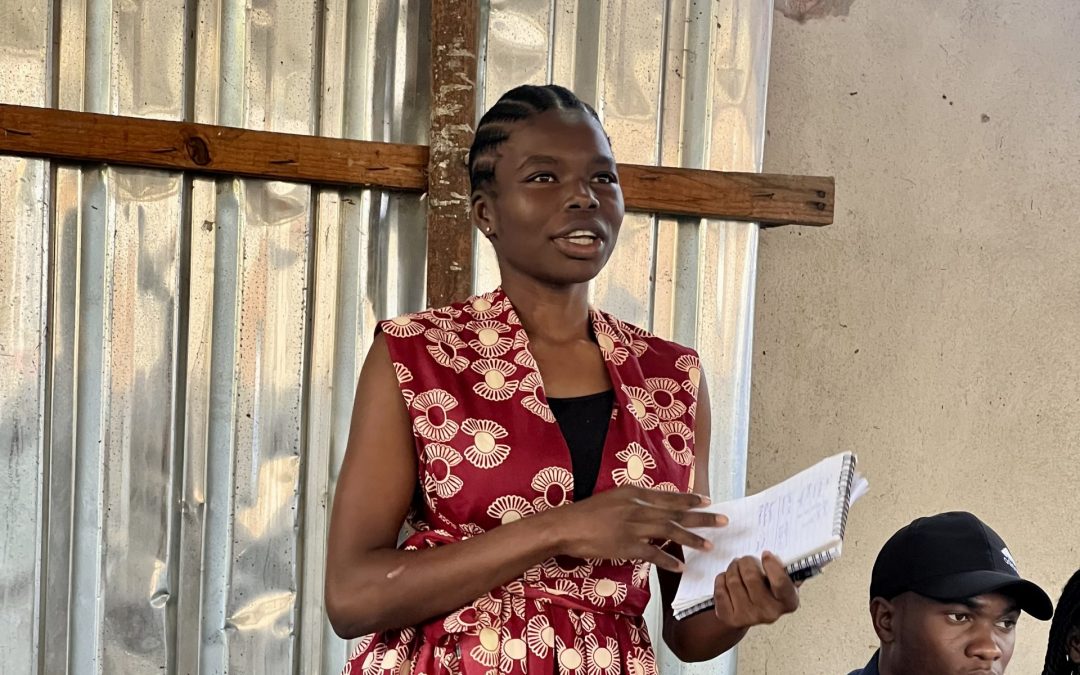
Photo credit (top image): Maria Katharina Moser
Note: This article gives the views of the author/academic featured and does not necessarily represent the views of the Global Development Institute as a whole, AEDHH, or Bread for the World.
Please feel free to use this post under the following Creative Commons license: Attribution-NonCommercial-NoDerivatives 4.0 International (CC BY-NC-ND 4.0). Full information is available here.