
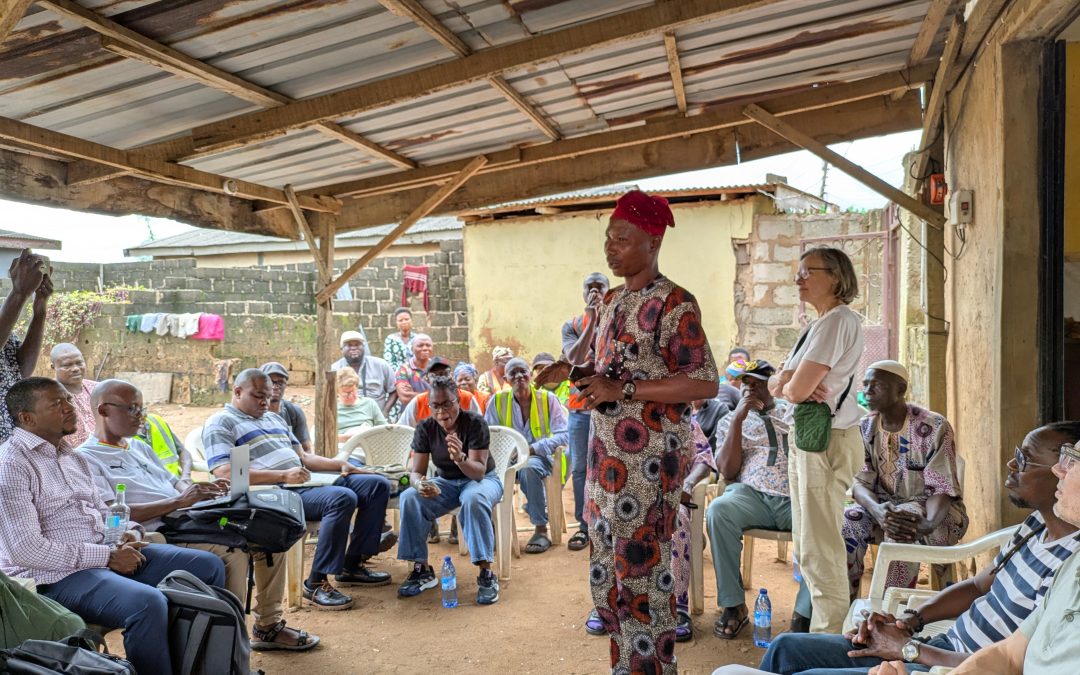
As GDI celebrates recent successes at the University of Manchester’s Strategic Partnership Awards, we’ve been reflecting on what makes an excellent partnership and the role of academics in producing data and knowledge alongside community members and local organisations. In this interview, GDI’s Research for Transformation Lab Manager, Helen Underhill, speaks to Joe Muturi, President of the Global Slum Dwellers International (SDI) network and Chair of the SDI Board about the ethical considerations facing researchers conducting such work.
With roots tracing back to the 1990s, SDI represents a network of community movements across Africa, Asia, and Latin America, all with the aim of improving the lives of people in informal settlements. With many years’ experience in building relationships between academic researchers, government- and city-led projects, and the residents they affect, Joe has plenty of first-hand wisdom to offer about the benefits, challenges, and power dynamics that partnerships can generate.
* * *
Despite chairing a global organisation that represents over 1 million people living in informal settlements / slums across the world, Joe Muturi continues to make time for people like me to learn and better understand the many powers of the Slum Dwellers International (SDI) movement.
Over three conversations, in-person and online, in the summer of 2026, I was incredibly fortunate to talk with Joe and learn from some of his many insights into research partnerships and the knowledge production system as part of a wider project I’ve been completing on participatory research and equitable partnerships. The project explores participatory research and research partnerships in global settings, uncovering reflections from both the ‘researcher’ and the ‘researched’ communities to deepen understanding of this work across the University and support more equitable work.
SDI is a core partner to the Global Development Institute in a relationship that spans over 3 decades, but the organisation continues to be involved in projects with researchers, practitioners, policy-makers and think-tanks from across the world. SDI’s profile and ways of working is such that Joe can represent the movement at the UN one week and attend a community-led meeting the next.
In our discussion around research partnerships, Joe’s reflections are underpinned by a critical issue that goes beyond an individual researcher: the challenge is not simply how to create better (equitable?) partnerships, but how to fundamentally rethink the relationship between knowledge, power and action. SDI’s collaboration with GDI has shown communities are not passive recipients of research: they are knowledge holders, political actors, evidence producers and partners in shaping and building change.
It is of note that our exploration of research (the processes, purposes, impacts…) turned to values and principles that guide research partnerships, and the ethical challenges that emerge. There are implications for us all to reflect not just on research practice, but how research systems themselves recognise and distribute power.
Unintended Consequences
For researchers undertaking work in settings like Nairobi’s slums, Joe presents a critical question that should, arguably, reframe how universities think about and institutionalise ethics across a research project or partnership: What are the consequences of this research for the people who remain after the project ends?
In asking this question, Joe frames ethics as an ongoing responsibility to people and communities long after the researcher has left, highlighting how equitable research partnerships need to move away from procedural ethical compliance to relational accountability. Researchers may complete all institutional requirements but still create harm if they fail to understand local realities or publish information that exposes individuals, organisations or communities to risk.
One area of concern is data ownership and publication, where ethical responsibility extends beyond collecting data safely. It includes considering how findings are used, who accesses them, and what effects they may have within highly complex political and social environments. As Joe reflects, in some contexts, “there will be repercussions, there will be consequences. Somebody might read that report… They will face the consequences of whatever you publish…Are you going to publish my name?… Put me at risk?”
This is particularly important in contexts where informal governance systems, political interests, police involvement and local power structures intersect. Seemingly neutral information can become highly sensitive when it reveals relationships between land ownership, local elites, gangs, service provision and state actors. Research tools that fail to recognise these dynamics can inadvertently expose participants or create conflict.
Ethics, therefore, is not simply about protecting individuals during research. It is about protecting communities after the data has been collected and as it enters the world.
Community Ownership of Data and Knowledge
SDI’s long history of organising through community-generated data highlights an important issue for global research: ownership of data. Who owns knowledge, who controls data, and who ultimately benefits from research? Joe’s position is clear: communities should not simply participate in research processes, they should retain meaningful ownership over the knowledge, data and evidence that emerge from them.
This perspective stems from SDI’s core way of working: “SDI organizes around data collection, mapping, building evidence. And I think for us, the evidence that we build is used to negotiate leverage for services.” For SDI, data is not simply a research output or an academic resource. It is a strategic tool used to negotiate with authorities, advocate for services and make visible the realities of informal settlements.
This is where academic partnerships have played an important role. Joe describes how community-generated information was often dismissed by city officials until it became associated with universities. The information itself did not change, but its perceived legitimacy did. He reflects, “when we used to collect this information on our own, they [government] never used to take it seriously. But all of a sudden when we started working with academia… academia gave community data some sort of credibility.”
However, this credibility also creates new tensions around ownership. If community knowledge gains value through academic validation, who then controls it? Joe’s concern is that communities frequently generate data, provide access and contribute expertise, but lose influence over how that information is subsequently used. He therefore insists that ownership must be discussed from the outset of any partnership.
Community ownership, in his view, extends far beyond access to datasets. It includes ownership of narratives, maps, histories and representations of place. It also includes the right to determine how information is used and who benefits from it. As he notes later in our conversation: “For us, the bottom line, as always, is: is data owned by the community?”
Viewed in this way, ownership of data becomes both a practical and ethical principle for building equity within the processes of research – including participatory work – and in partnerships. Ownership is about ensuring that communities retain agency over the knowledge they help create and that research strengthens rather than weakens their capacity to advocate for themselves and their communities.
Research Extraction and the Production of Expertise
A common critique levelled at academic research concerns how often it becomes extractive, even if this isn’t the intention. Joe’s observations of much academic research reveal how extraction operates not only through data collection but through the unequal production of expertise and authority.
Joe describes a familiar cycle: researchers arrive, spend time with communities, collect stories and insights, and then leave. Communities provide access, introductions, interpretation and local understanding. Researchers then transform these interactions into publications, conference presentations and professional credibility, gaining promotion and career success: “somebody will come sit with me 30 minutes, I’ll take him around, all of a sudden they are publishing something and they are an expert on this and that.”
The concern is not that researchers publish. Rather, it is that the process often converts collective knowledge into individual expertise. Communities become sources of information, while researchers become recognised authorities. In one project example (he asked me to not name the specific work), Joe recalls how external organisations position themselves as experts on locally led adaptation, despite communities having done much of the underlying work:
“I will contribute. I will take you. I’ll give you my team… organise focus groups, discussions. There will be no acknowledgement… They publish your work because you don’t have resources to publish. And then all of a sudden, voila, they become the experts on whatever work you have done.”
Our discussion went beyond formal publications, returning to the questions around principles, values and ethics of academic work and how it is mobilised within policy and practice as we shared our concerns about the everyday ways that academic systems reward certain forms of knowledge while overlooking others. Researchers gain citations, promotions and reputational benefits, yet community members who provided access, historical context and practical understanding frequently remain invisible.
For Joe and many others like him who hold positions that see many requests for support with research projects, this invisibility is particularly frustrating because he sees so starkly how communities contribute much more than data. They provide interpretation, facilitate relationships, identify appropriate participants, explain local politics and help researchers avoid mistakes. Yet these contributions are rarely acknowledged. Addressing extraction, therefore, requires more than better consultation: it requires a fundamental shift in how expertise is understood, recognised and rewarded.
Indigenous Knowledge and Local Expertise
Underlying Joe’s critiques of knowledge production, ownership of data and research practices that fail to acknowledge the communities that make the project possible is another issue of power: the unequal status of indigenous and local knowledge.
Joe argues that the knowledge systems around academia and policy-making privilege formal expertise while overlooking the lived expertise of people who have spent decades navigating the realities they seek to understand. In one example of how one university team produced what he viewed as a conventional explanation of informal settlement growth centred on rural-urban migration and economic opportunity, he notes that the team reported findings the communities knew and had been responding to for months, even years. Instead of repeating work already done, he looks for researchers who will work with them, co-create and co-design to “tell us something we don’t know.”
These situations arise when the researcher arrives with assumptions drawn from academic publications rather than out of curiosity and a recognition of local knowledge. “We [SDI] tell them [researchers], don’t come with assumptions. Come with a very blank slate like, I’m here to learn to understand how things work.” Approaching research through curiosity will allow us to ask the questions that can support communities as they are now, taking into account the lived and experiential knowledge within the current context.
For example, in one transformative project, communities wanted a deeper understanding of how the settlement actually functions, not another piece of work describing the problem. Communities wanted to ask about the system and structures that shape where they live: Who controls land? How are decisions made? Which actors hold influence? How do informal governance systems operate? Joe argues that the insights necessary for change can emerge only when researchers recognise local people as experts rather than respondents, and as people who can identify gaps in knowledge and the questions that need to be asked. This requires researchers to acknowledge and respect that “there are people who have been living there. They know the history. They know how things work. They know the structures, the systems. They know the culture.”
These kinds of highly contextualised and grounded knowledges are not anecdotal. Rather, they are highly sophisticated and often essential for understanding how interventions, services and governance function in practice. Ignoring community-based knowledge can lead to research being designed in a way that (albeit, unintentionally) fails to ask the questions or use approaches that could support the community’s goals or needs and, ultimately, share inaccurate or incomplete accounts.
How Successful Partnerships Are Built
One of the incredibly powerful aspects of being able to talk with someone like Joe who has worked with researchers and academics, activists, politicians and policy makers from all over the world is hearing his reflections on the processes of research and the wider impacts that these can have. He has a unique insight into understanding how people from different worlds work together to create change, and the possibilities that could emerge, if only we could connect more of those spaces and really understand what we could each bring to understanding, then responding to, a challenge.
Reflecting on the positives of the connections that are made possible through meaningful, equitable partnerships, Joe highlights many ways they can be built differently. It’s reflective of Joe’s belief in possibility is that he often cites concrete examples of what successful partnerships look like as he explores why some relationships endure and others fail.
For example, Joe cites the partnership between SDI and the University of Manchester which has developed over 30 years to highlight what becomes possible when relationships are built over time. Whereas more transactional forms of engagement lead to surface-level research, the time invested in carefully building relationships with researchers who “don’t come with assumptions… they say, ‘let’s develop this together” has resulted in the co-creation of transformative knowledge and practice seen with ambitious projects like the African Cities Research Consortium (ACRC) led by GDI.
Joe describes GDI as having become a research partner that approaches communities differently: the relationship is a genuine collaboration that goes beyond institutional arrangements by recognising the importance of relationships, continuity and a willingness to learn collectively. Successful partnerships are built through practices that demonstrate respect in tangible ways. These include co-designing research questions, recognising community expertise, investing in local researchers, sharing authorship and creating outputs that communities themselves can use. They also involve understanding what has already been done rather than repeatedly “discovering” issues that communities have been working on for years. As he observes: “A good researcher identifies what are the gaps.”
Perhaps, therefore, the most important factor in building successful partnerships in the investment in time and pushing back against the short-term horizons of research funding and project cycles, knowing that transformative change is “a long-term investment… it’s not going to happen in two years.”
Conclusion
Trust, credibility and mutual understanding – foundations of equitable partnerships and transformative participatory research – are not outputs that can be delivered within a grant period. They are accumulated through repeated interactions, shared experiences and a demonstrated commitment to collective goals. The longevity of the Manchester-SDI relationship is therefore significant not simply because it has lasted, but because it has created the conditions for a different kind of research relationship, one based on co-creation rather than extraction. In conversation with Joe, it is clear that successful partnerships are not simply about generating new knowledge. They are also about creating pathways through which existing community knowledge can gain recognition and influence and be put to work within the organisation’s advocacy strategy. The strategic challenge for universities is therefore to use their institutional legitimacy to amplify community voices and knowledge rather than speaking on behalf of them.
A truly equitable partnership does not replace community voice with academic authority. Instead, it helps ensure that community evidence is heard, respected and acted upon within policy and decision-making spaces. This is a subtle but important distinction. Strong partnerships do not begin by asking what researchers want to study. They begin by understanding existing knowledge, recognising previous efforts and working with the communities to identify where additional evidence could make a meaningful contribution. Researchers also need to consider not only whether they can collect particular information, but whether they should; not only whether communities have consented, but whether communities retain agency over how knowledge is used. Questioning practice around data collection is key to ensuring communities become co-authors of understanding rather than suppliers of data or facilitator-fixers.
The strategic implication is that future research partnerships should be evaluated not simply by the quality of outputs, but by how ownership is distributed and how it supports that community: Who designed the questions? Who interpreted the findings? Who received recognition? Who benefits from publication? And, as Joe asks, “what value does it add in our advocacy strategies?” Transformative partnerships require a shift from participation towards genuine co-ownership of both process and outcomes where accountability to communities remains long after data collection has ended.
Co-ownership as a principle reflects a commitment to build partnerships over time and to adapt and learn together. Where relationships are built not as the result of a single project but as the accumulation of years of shared experience and deepening trust, a reality that sits in contrast to many research systems that expect transformative outcomes within two- or three-year funding cycles, challenges can be met with openness that makes transformative learning possible.
To conclude, communities are not waiting to be discovered, understood or empowered by researchers. They already possess knowledge, relationships, histories and strategies for change. The role of a good partnership is not to lead those processes, but to strengthen them. The most successful research partnerships are not those that produce the most publications, but those that create the conditions for communities to exercise greater ownership, voice and influence over their own futures. Taking this on has profound implications for universities and funders. If transformation depends on trust, and trust depends on sustained engagement, then partnership-building should be viewed as a core research activity rather than an optional addition. Long-term relationships are not simply a means to better research; they are often what makes meaningful research possible in the first place.
Note: This article gives the views of the author/academic featured and does not necessarily represent the views of the Global Development Institute as a whole.
Please feel free to use this post under the following Creative Commons license: Attribution-NonCommercial-NoDerivatives 4.0 International (CC BY-NC-ND 4.0). Full information is available here.