
By Daniela Cocco Beltrame and Teklehaymanot Weldemichel
Emancipation from the oppressions humans have inflicted on one another is, necessarily, collective. There is no individual escape route. As the often-cited words attributed to Lilla Watson remind us: “If you have come here to help me, you are wasting your time. But if you have come because your liberation is bound up with mine, then let us work together.” This is not a polite invitation but a political and philosophical demand that development studies as a field has too often failed to meet.
The starting point: Invisibilised conflicts seeing each other
Among others, the ongoing genocide of Palestinians in Gaza has exposed the limits of hegemonic institutions with painful clarity. Nations and major intergovernmental bodies were either unwilling or slow to act, tailored their language in service of violence, or stayed silent in ways that will not be forgotten. And yet, from that same catastrophe, something remarkable is emerging: waves of solidarity from people and communities who know, intimately, what it means to be abandoned.
Organisations and activists from conflict-affected contexts such as Sudan or Tigray have spoken out in solidarity with the people of Gaza. Far from being gestures from a safe distance, these expressions are lived experience recognising lived experience. People enduring their own unimaginable hardships recognise that Palestinian suffering is connected to their own. This solidarity is more than a statement of principle, it is a practice of emancipation.
But sometimes oppressed peoples struggle to truly see each other. Recognising oppression takes work. It requires building political consciousness, learning to read media distortions, and interrogating the language chosen to describe suffering. Dominant narratives tend to demand simplified stories, and that flattens the complexity within conflicts. Thus, solidarity becomes harder to build, and certain struggles get ignored as a result.
It is through persistent acts of connection that we overcome this invisibilization. These emerging and re-emerging spaces contribute to raising broader consciousness about the ties that bind emancipatory movements across the planet.
All struggles, the struggle, one might say.
The horizon: Deep solidarity
What does it look like when solidarity runs deep enough to reshape knowledge production and engaged scholarship?
Academics most directly affected by invisibilised conflicts are increasingly connecting with one another, refusing to wait for institutions to set their agenda. For instance, scholars working on the Tigray conflict, where a brutal war claimed hundreds of thousands of lives with minimal Western media coverage, have built networks to document atrocities, preserve testimony, and push back against silence. Researchers from Sudan have similarly centred Sudanese voices’ analyses of a conflict that has triggered one of the world’s worst displacement crises. Iranian scholars and activists have worked to sustain international attention at moments when news cycles move on.
For academics not directly affected by these conflicts, a different kind of work is required. Paul Ricoeur, writing on selfhood and otherness, suggested that “every self is in fact another” (Ricoeur, Oneself as Another, 1992). So, in hearing other people’s stories, we hear something of our own, and this clarifies things for ourselves. This kind of empathy has practical implications: standing in solidarity with “others” is a form of self-understanding and self-realisation. This means taking on responsibilities rather than merely expressing sympathy. It means removing institutional hurdles where one has the power to do so, and trading privilege for accountability and collective power.
Deep solidarity is a normative horizon, a street-level utopia that takes a step back whenever we take a step towards it. And, paraphrasing Eduardo Galeano, what is utopia good for? Well, to keep us walking.
The path: Look for the absences
Much of the most important work in global development is about learning to notice what is missing. Mainstream media, international policy frameworks, and academic publishing all have silences built into them. Structured by geopolitical interest, funding flows, and the prestige economies of knowledge production, these silences are pervasive. To name just a few symptoms of these systemic flaws, the Tigray genocide received a fraction of the coverage given to conflicts in which Western interests were more visibly implicated, and Sudan’s devastating war has been chronically underreported.
We must, then, look for the absences. As knowledge workers, we are professional absence seekers; that is the methodological implication. We must ask whose voices are missing from the news space, whose ideas never made it to a policy document, whose expertise is treated as ordinary lived experience… and whose as scientific, rigorous knowledge.
For within these absences lies the future of development work, if it has one.
What kinds of institutions, what forms of governance, what scales of organising make sense in a world of planetary ecological crisis and resurgent authoritarianism? Much mainstream development discourse remains stubbornly state-centric, measuring progress by national indicators and directing funding through governments. But the nation-state as a unit of analysis is increasingly insufficient for understanding both today’s conflicts, wars and genocides, as well as for the solidarities emerging in response to them. This is a challenge that development studies must take seriously.
As much as ‘deep solidarity’ is a normative horizon to keep us walking, grassroots-led multilayered governance that connects a neighbourhood’s mutual-aid network to a transnational advocacy coalition is not a utopian fantasy. It is already happening. Development scholarship and practice just need to catch up.
The company: Towards an umbrella space
The work of liberation, as Watson and many more constantly remind us, is bound up across all of us. The task is to build the spaces where that binding becomes legible and actionable. So, what might it look like to give a shared home to these interconnected emancipatory aspirations?
There is a growing need for umbrella spaces. But shaped as what? A history of organising attempts points towards platforms or federated networks (see for example wiego.org and sdinet.org). In this case, spaces would be dedicated to amplifying activism and scholarship around invisibilised conflicts. Perhaps porous, honest, caring spaces that hold room for error and correction. Perhaps led by those at the heart of conflicts and genuinely capital-S-supported by allies that believe in the ‘self-as-other’ philosophy. Perhaps spaces where we stubbornly insist on critical thinking around the connections among struggles as the way towards social justice beyond current models.
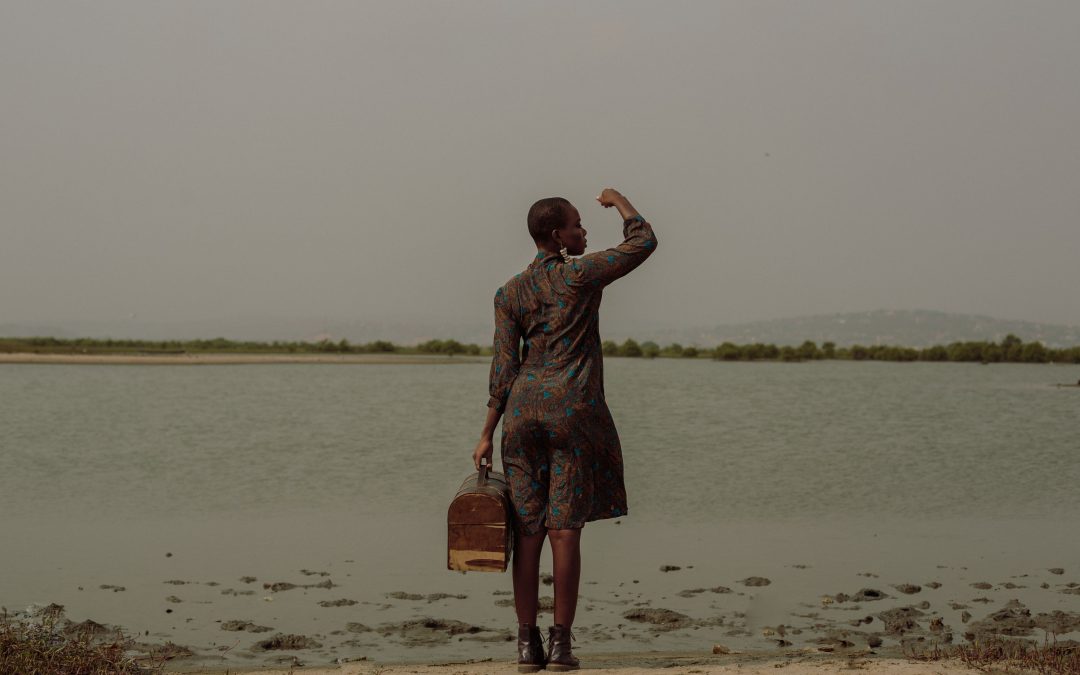
Photo by Apex 360.
Note: This article gives the views of the author/academic featured and does not necessarily represent the views of the Global Development Institute as a whole.
Please feel free to use this post under the following Creative Commons license: Attribution-NonCommercial-NoDerivatives 4.0 International (CC BY-NC-ND 4.0). Full information is available here.